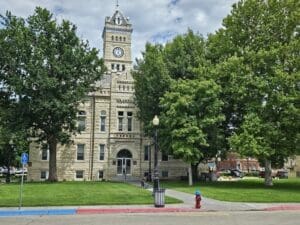
In 1897, Frishman’s Dry Goods Company was located in Gollober’s Hall at 721 5th Street. Peckham’s Grocery was most likely located on the north portion of the building. Frishman and his three sons remained in the dry goods industry for almost 30 years, dating from 1881. They were the subject of many lawsuits, causing them to move to at least three business locations. They were forced to close in 1894 but rebranded and opened a year later.

In 1902 the Gollober Building at 721 5th Street was renovated and became home to the mercantile business Johnson, Rose, and Company. An elevator was installed, as well as the ability for multiple commercial tenants. In 1906, Johnson-Rose sold to Eugene Starr and his two sons, and it became the Starr-Peckham Mercantile Company. Starr had previously lived in Clay Center when he ran his own dry goods store, The Regulator, located on Lincoln Avenue. Building namesake Nathan Gollober also owned part of the business, as did Scott Brant.
Starr-Peckham occupied both stories of the Gollober, with a stone archway that led to Peckham Grocery. By April of 1906 a glass door was added on the north end, and bay mares were purchased to pull the store’s delivery wagon.
In 1908, Nathan opened the Gollober-Colling Clothing Co., which occupied two rooms on Lincoln Avenue. It was interchangeably called the Toggery or the Gollober Clothing Company, and offered cash-only prices like $1.50-$3 on fancy vests. ($48-97) A fire was extinguished in 1912, and soon after the men decided to sell. A 1913 newspaper read, “WE QUIT THE CLOTHING BUSINESS.”
In 1909 Peckham also sold, retiring after 32 years of business on the 5th and Court corner.
Around this time, Nathan Gollober retired and left business ventures to his son, Arthur “Art,” who was 49 years his junior.
A trained architect, Art planned extensive improvements for the building at 5th and Court. They began in 1913 when the building was still occupied by Starr Mercantile Co. Seeing potential in size and location, Art traveled to Abilene where he toured another large building and took notes for his project. The building was planned to become “one of the finest places of business in the city.” John Kasper was granted the construction contract, which included an entire new front for both stories and the Court Street side, new ceilings, and an electric elevator. The project was most likely finished in 1915, which is displayed on the building today. Between $15,000-$20,000 was spent on the remodel, while high-ups hoped it would cause additional downtown renovations. ($484,572-$646,096.)
Arthur continued with the sale of the Lincoln Ave. building. A “misunderstanding” arose between the Starrs and Art, resulting in a double lawsuit. The Starrs moved next door and won $1,142.90 in the decision (Almost $47,000 today). The Gollober building became occupied by Guest Dry Goods in 1914. When opening, Guest sold most clothing items, along with fabric or flour sacks for sewing.
In March of 1915, the Starr-Gollober lawsuit verdict resulted in a payment of $1,142.90. (Nearly $37,000 today.) However, Art remained a partial owner of Starr Mercantile stock until he sold it back to the Starrs in 1916, two years after the suit.
Rent for the upstairs offices in the Gollober was listed between $8 and $12.50, which included steam heat, cold and hot water, toilet privileges, and electric lights. ($245-398).
After an early 1920s election, the outgoing and incoming County Attorney exchanged offices between the Courthouse and Gollober’s upstairs.
In 1921, the building was sold to Frank O. Oberg and Murrey Smith when Art and his wife, Maude, moved to California. (Maude’s brother-in-law was Edwin Landon, who owned Star Steam Laundry.)
Murrey (1881-1966) was one of three brothers selling cars, then farm equipment, at W.W. Smith & Sons. He served as the Mayor of Clay Center from 1913-1914 and served on the Union State Bank board of directors for more than 50 years.
He was a member of the special committee that worked on the Milford Reservoir. The committee successfully lobbied for a Republican River dam in Harlan County, Nebraska, which was completed in 1952. Located seven miles from the Kansas border, the Harlan County Lake extends into northern Phillips County, Kansas.
However, the reservoir near Milford, KS, which began construction in 1962, was considered a defeat by the committee.
After Smith and Oberg’s purchase of the Gollober Building, Guest Dry Goods store and other upstairs businesses remained. “Consideration” or sale price of the building was $30,000, as reported in the Economist. ($538,768.16)
Guest Dry Goods operated in the Gollober building for 40 years, at which it hosted a closing sale with dresses for $1 in 1955.
Research by Susan Hammond