“The Jeans that Built America,” AKA Lee Denim, was founded in Salina, Kansas.
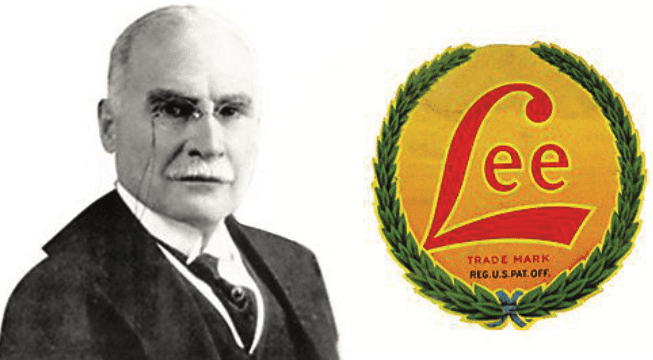
Dating back to 1889, namesake Henry David Lee founded the HD Lee Mercantile Company. Along with four business partners, Lee sold groceries, dry goods, and more. The company specialized in sourcing hard-to-find food items that could not be grown locally before growing to become a major food distributor between Kansas City and Denver.
Born in 1849 in Vermont, Lee was the 8th of 10 kids. The family patriarch died when Lee was just 4, leading him to the foster system, where he lived until the age of 12. As a teen, Lee moved to Galion, Ohio when he became a hotel clerk and purchased real estate. The rest of his family remained in Vermont while Lee moved to build a fortune. Over three years, he saved $1,200 to purchase Central Oil of Galion, which was failing at the time. (Just over $35,000 today.) After raising it to success, half of the company was sold to John Rockefeller’s Standard Oil in 1886, while Lee remained president of the remaining half. He retired in his 30s after his doctor told him to live in a drier climate due to Lee’s tuberculosis. This led him to sell the remaining shares and head west.
Lee moved from Galion, Ohio as a rich man, convinced he could build a second fortune after he was forced to take time off due to health.
The town of Salina offered $25,000 for a mercantile business, along with $100,000 from Lee’s investors. ($877,847 and $3.5 million in 2025.) And thus, the location was settled.
The area’s first non-ag business was opened at the corner of Elm Street and Santa Fe Avenue. In 1903, a fire claimed the business’s first building. It was so large that local schools were shut down, leaving children to watch flames from the street. The fire caused $600,000 in damage. (Nearly $22 million today.) Lee called customers to pay due invoices, which raised enough funds to rebuild. In 1904, he ordered two, five-story brick buildings on the six-acre lot.
As business grew, so did what the store offered its consumers. With a year, HD Lee Mercantile’s 1899 catalog offered air rifles, baseball mitts, bib overalls, coffee grinders, fabric, school supplies, toilet paper, and more – all in addition to food items. Between 1900 and 1909, Lee founded three more companies: HD Lee Flour Mills Company, Lee Hardware Company, and the Kansas Ice and Storage Company. He also helped found the Salina Farmers’ National Bank.
In 1911, Lee designed the first overall, called the Lee Bib Overall, made in eight-ounce denim and complete with a button fly and a multi-use chest pocket.
By 1912, he saw the need for a garment factory, which was also placed in Salina. It’s said Lee had trouble finding enough clothes or consistent quality for his store. This led him to start his own denim factory. Its original purpose was to produce work overalls, dungarees, and work jackets. The thick, undistressed denim was known for its durable nature and was often worn atop clothes to keep workers protected in a factory setting. (Later years would focus on this with the “Can’t Bust ‘Em” motto.)
However, in 1913, they were approached by a local car mechanic who asked the factory superintendent if the jeans and jacket could be sewn together for a single piece of outerwear. Other reports state the Union-Alls were Lee’s own idea. In either case, the garment is needed not just for hard laborers, but also for daily drivers. With cars being unpredictable, it was common for car owners to work on their vehicles, which was a dirty job. With the introduction of the “Union Suit,” Lee began boasting that a pair was kept in every car.
In 1914, Lee patented the term Union-Alls and produced them in all sizes, including men’s and women’s cuts. It’s likely that the success of these Union-Alls is what made the Lee Company what it is today.
The Union-Alls were seen by Brigadier General Leonard Wood (namesake of the modern Fort Leonard Wood in south-central Missouri) , who ordered sets for doughboys during WWI. The uniform was known as “the fatigues that can’t be worn out.”
In 1920, a pair of Union-Alls likely cost between $2.50 and $3. ($40-$48)This was at a time when a low-paid laborer earned $25 per week and $1,400 a year. ($403 and $22,600, respectively.) Thus, a good pair of Union-Alls cost a day’s wages. (Today, a pair of men’s Lee Union-Alls costs $149.95 while the average factory worker’s salary is $16.80/hour. Still just over a day’s wages.)
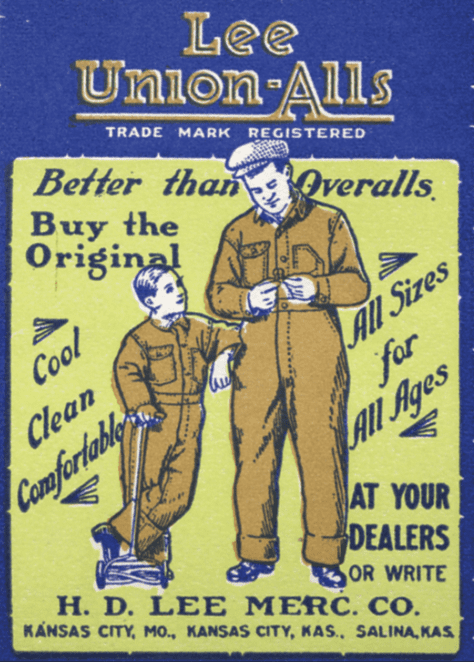
With rapid growth, H.D. began searching for larger towns to place factories. Soon, a Lee location was opened in Kansas City, South Bend, Indiana, Trenton, New Jersey, and Minneapolis, Minnesota, all from 1917-1919. And from 1915-1919, Union-Alls were the only product made due to such high demand. The larger cities were utilized for both their workforces and lower freight rates.
In 1928, “Mercantile” was officially dropped from the company name, leaving it the HD Lee Company.
The headquarters were moved to Kansas City in 1950, 22 years after Lee died of a heart attack at 89. The twin factories sat empty until 2019, when they were purchased by a collection of property developers and the Community Housing Development Corporation of Central Kansas.
More than $20 million was used to refurbish the historic HD Lee Complex into commercial and residential spaces. However, certain original features were left intact, including original brickwork and indigo dye, which still stains the buildings’ floors.
Multiple phases have been announced, with the first (HD Lee Mercantile building) being unveiled in 2020. Phase two, the Lee Hardware building, opened in November of 2024 with 50 units ranging from one to three bedrooms. Current residents of the Lee Complex may earn up to 80% of the area’s median income.
Phases three and four of the project include the storage lofts and denim store. In total, the project is projected to cost more than $40 million.
Today, the original Lee buildings remain a National Historic Landmark.