The first report of a telephone exchange in Clay Center was listed in 1887 with less than 100 phones. The location’s manager was Almira “Allie” Peckham. She was an 1882 graduate of Kansas State Agricultural College and sister of longtime grocer, Will Peckham. She left the profession after marrying “Old Tom” Cordry, newspaper employee of the Clay Center Times, and the pair moved.
Under Allie’s management, an 1887 ad read, “But don’t come out here expecting to find an antiquated and dried-up country town with whistlers on the store boxes. We tell you, we are a city.”
By 1903, businessman Gilmore (GM) Stratton received city approval to build and maintain phone lines throughout town. It came with rights for 20 years.
By May 15, 1907 he had revamped the business, formerly owned by the Trice Bros, and renamed it the Clay Center Telephone Company. At this time, less than 700 phones were in the town.
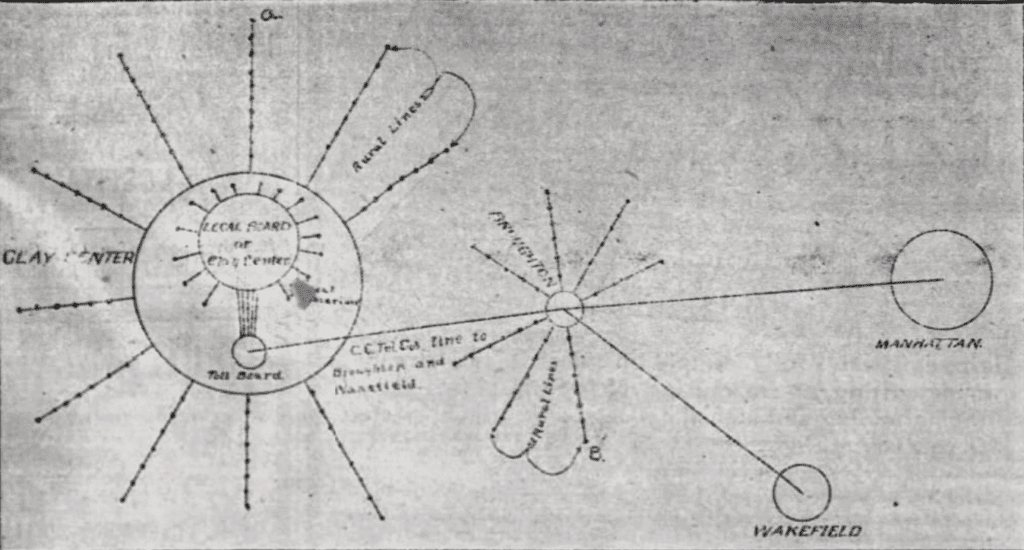
In 1907 the CC Telephone Company published a series of letters and facts about a dispute between the exchange in Broughton. Allegedly, the Broughton exchange accused them of excess bills and wanted 5¢ paid for their own telephone operator. The Clay Center location also published a map of how the exchange operated at the time.
The same year, United Telephone Company in Concordia caused a stir by raising monthly fees for desk phones by .50¢, bringing the monthly cost to $2.50. ($17.18 and $85.92, respectively.)
By 1910 the location had more than 1,000 phones, including personal and party lines. (A party line was a shared phone line between multiple houses.) The company employed 10-15 employees.
Stratton owned the company for nine years, bringing it to 1,230 phones. In 1916 he sold to the United Telephone Company, headquartered in Abilene. The company also managed exchanges in Minneapolis, Beloit, Concordia, Abilene, and Belleville.
With the purchase, UTC announced a two-year expansion, spending $30,000 (more than $757,000). At that time, they had purchased $4,000 in conduit (nearly $101,000) and 12 manhole covers that would be placed on 5th Street from the Baptist Church to the length of road pavement of the time. It was projected to be “One of the best systems in the state.”
By 1917, they announced they would spend a total of $50,000 on the expansion (more than $1.26 million in 2025), including a $12,000 exchange board and $10,000-$15,000 on underground lines. ($302K, $252, and $378K, respectively.)
Research by Susan Hammond
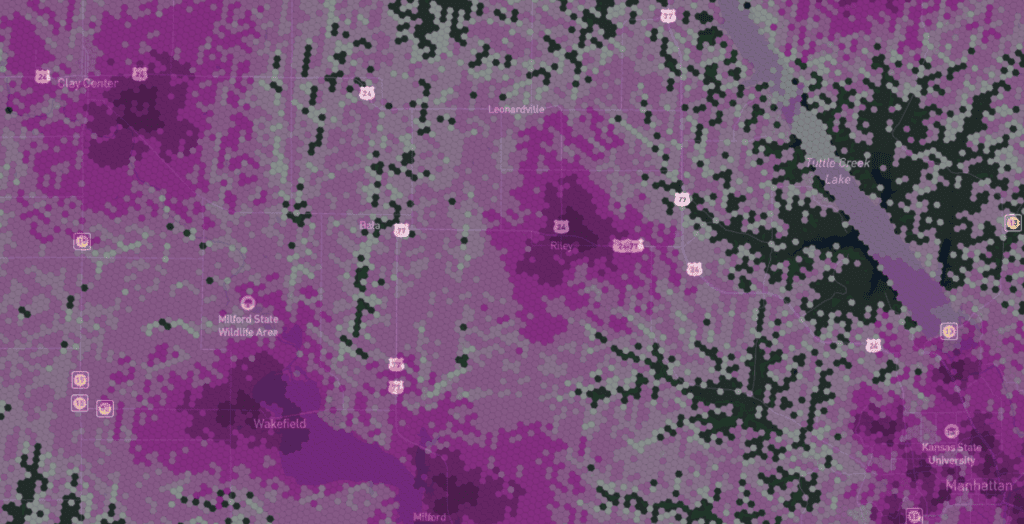
Top: The Clay Center Telephone Company published their coverage map in 1907. Bottom photo: coverage map of one of four wireless services that encompass the area. Data from the FCC.