In 1906, three brothers started a construction business in Green, Kansas. Harry, Leigh, and Benjamin Sanneman founded Sanneman Brothers Construction Company, which was later joined by two additional brothers, Peter and Ramer.
Their father, Hinrich (Henry) moved to the U.S. from Germany in the 1860 along with two of his brothers. He married Trientje “Treeny” Katherine Hovenga and the pair had 13 children. Treeny died just three weeks after giving birth to their youngest, leaving 8 kids who were 12 and under.
Family lore said Katherine told her sons to find work other than farming because there was too many of them to survive off of the family land.
The Sanneman Brothers were known around the state for their abilities; in the mid-20s, a newspaper said they were the largest construction company to ever operate in Clay County.
Brother Pete managed The Green Lumber Company before transferring to work as the general manager of the Kansas Lumber and Coal Company in 1916. He held this role for 12 years before joining his brothers.
The construction company typed their name on each piece of lumber, which was often seen in later decades through construction projects and remodels.
In 1918, their youngest sister, Cassie (Sanneman) Stevens, lost her toddler son, Ralph, when he was attacked by hogs. It’s believed that Ralph climbed the fence and fell in. Though his mother retrieved him from the pen, Ralph died the next morning from his injuries.
Leigh died in 1919 at just 35; his official cause of death was not named, however, he had been traveling southwest to find relief from respiratory issues. His tool chest is at the Clay County Museum today.
In 1920, the company moved from Green to Clay Center when a newspaper article stated, “Nothing is too big for them to tackle.” The same article named them one of the best-known contractors in the state.
While building the Hiawatha Memorial Auditorium, Harry met his first wife, Bessie Cakler, when he was living on-site for 14 months.
Ramer (1888-1970) moved to Kansas City and Ben (1887-1951) to Topeka in 1927, where he continued as a contractor. Harry and Pete continued the business until Pete died in 1931 at 57 years old.
It’s unclear how long the business remained open.
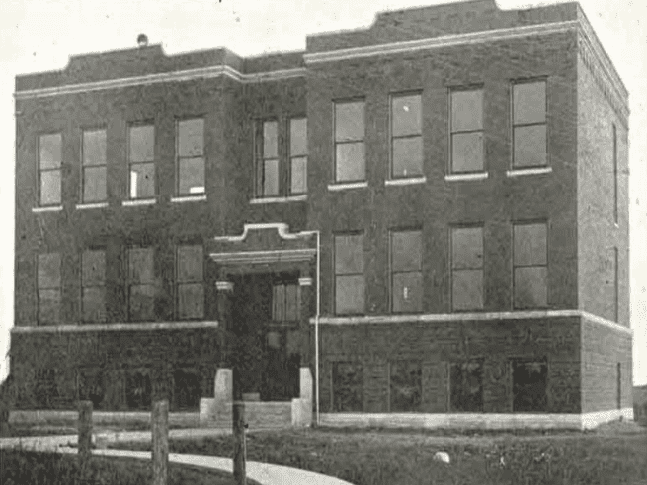
The company was credited for several homes and businesses across the state, including the Clay Center Carnegie Library with a bid of $10,540 in 1911 ($359,442 today), the former Clay Center pool, grade schools in Green, Miltonvale, and Leonardville (1909). They also purchased the former Bonham Opera House at 816 5th Street and remodeled it to host businesses and offices. Though it was once called the Sanneman Building, it’s now known as the former American Legion. The brothers tore down and re-built the building’s front, took off the upper floor, and redid the floor plan, removing the theater.
In 1917, they won a bid to build an addition to the Clay County High School on the north side of the lot. The annex was approved August 21 and scheduled to be complete December 20th, when it would start housing manual training and domestic science classes. The bidding process worked by submitting a certified deposit check, $10 each for general plans and heating and plumbing plans. ($253.11 in 2025.) Next, certified checks for $150 for general and $100 each for plumbing and heating are provided with the bid. ($3,796.59 and $2,531.06) Plans could be returned at that time. Larger checks would be deposited if the construction company failed to obtain a bond within 15 days of their contract.
In 1923 the brothers remodeled an “orphan’s home” near Manhattan, which was owned by the Odd Fellows or IOOF. The same year they were hired to complete at $30,000 city-county community building in Chapman, then add a $10,000 garage. ($568,378.95; $189,459.65)
They also built the new Rhode Island Railroad depot for $30,000. Five years later, they were hired to put a $150,000 expansion on the IOOF facility. ($2,841,894.74) The organization paid by charging each member $1 per year for three years. ($18.95)
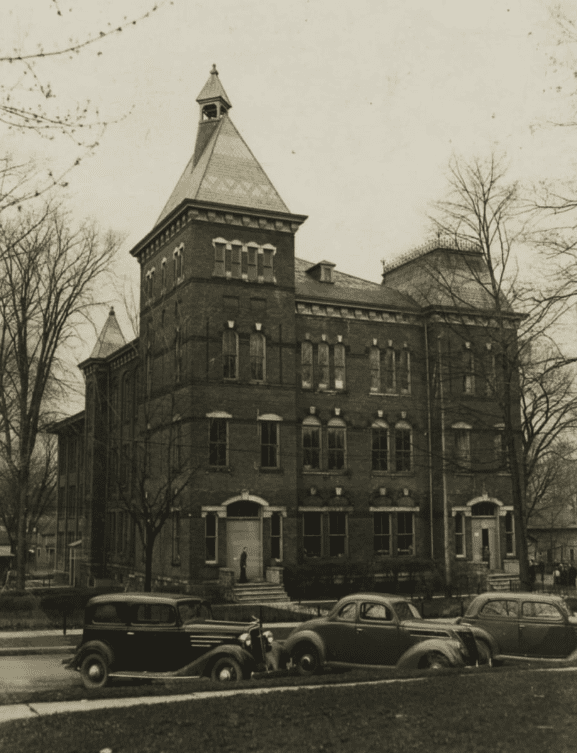
Also built by the brothers were the high school in Clyde, a 1907 bank in Oak Hill, and the Farmers Union coal and cement house, erected in 1916.
Research by Susan Hammond
Top left: Clyde High School; above right, Leonardville School, completed in 1910. It operated from 1911 until 1959 when Leonardville and Riley consolidated. It held the town’s first high school classes until 1920 when a separate facility was used.