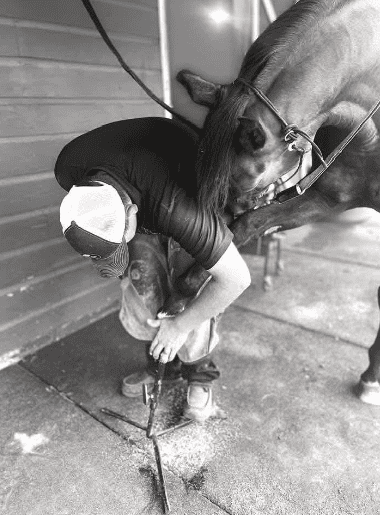
For 14 years, Ryan Strait has worked as a Farrier in north-central Kansas. Shoeing up to 30 horses a week, he travels to care for hooves across the region. Skunk Creek is a “one man show,” treating equine hooves.
All his life, Ryan Strait wanted to own a horse. Under his parents’ roof, it wasn’t an option. Growing up in the Kingman, KS area, Strait saw horses regularly but wanted to ride and care for one daily, just like his Dad had.
“If you’ve ever met a little kid that was just plain crazy about horses, that was me,” he said. “It was always a big fat nope.”
Then at 20, Strait said he got a life dosing of priorities. He enlisted in the Army National Guard, when he was called to serve a 12-month deployment.
“We did six months training at Camp Shelby, MS, right after Katrina,” he said. “Everything was destroyed. Then the plan was 12 in the big country.” However, due to a surge of troops coming into Baghdad and extension orders, it was 22 months before he made it home. It was the longest continuous deployment during Operation Iraqi Freedom, covering a full 22 months.
The following week he turned 22 and the week after that, he bought a horse.
“My buddy said, ‘I’ve listened to you complain for two years, you’re getting a horse,’” he said. “He grew up in the horse business so he helped me find one.” The pair loaded up a trailer and came back with a horse the same day.
He took a job on a farm and rode regularly, until an injury left him both out of the saddle, and out of a job.
Laid up with a fractured C6, Strait debated what to do for work going forward. That’s when his then-wife suggested shoeing horses.
“It was not a planned thing at all; it was really, seriously a half-cocked idea, a facetious comment while I was sitting there in a neck brace.”
With a family at home, he began training to shoe horses. In the U.S., there are no legal standards to perform the job, however, Strait said he wanted to be thorough. For three months he attended the Five-Star Horseshoeing School in Minco, OK.
“At the time that was my best option; I had one kid on the ground and another on the way. I had a limited amount of money and a limited amount of time to be gone.”
From there he landed a job at the school, where he got to both learn and earn a paycheck.
“Basically, I got six months of school and real-world experience,” he said. “I don’t know if they saw something in me but that helped financially because I had no income.”
One of the first things he learned is that to do the career, you have to love it.
“You can’t just shoe horses for a living, you have to live to shoe horses,” he said. “It’s easy to take that to an extreme and idolize your career in a way that’ unhealthy.”
Since finishing his initial Farrier course, Strait said he’s continued to learn and understand the inner workings of a hoof. He’s also a member of the American Farrier’s Association and in 2016 became a certified journeyman-level Farrier.
It was a test that included three parts: a written exam, forge a welded bar shoe in 35 minutes, then shoeing a horse with handmade plain stamp shoes with clips, this part in two hours.
By 2015, three years after leaving for school and building his business, he was finally earning a living through Skunk Creek, a name derived from a now-dry creek on family land. However, it was a time when his life took another turn when he went through a divorce.
“That was God’s way of shaking my life up and saying, ‘You have some addiction problems and are not a very nice person,” he said. “So I started my recovering journey, still shoeing, still taking care of my kids and going to clinics.”
He’s now nine years sober, remarried, and shoeing as often as the weather allows.
On average, horses need foot maintenance every six-eight weeks, he said. That might mean trimming and cleaning, or adding shoes. If just the former, he said a full day is 10-12 horses, and shoeing, no more than four horses is his “happy place.”
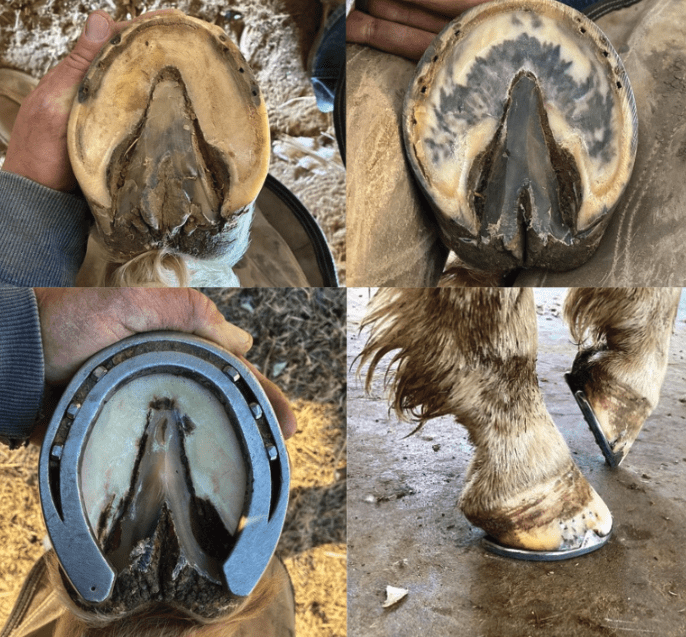
He compared horse hooves to fingernails, which can be trimmed and maintained on a horse’s foot.
Strait said shoes are placed for three reasons, if they are wearing out their feet faster than it grows, if they’re needed for performance issues, like sliding, which can’t be done without shoes; and if there’s a anatomy issues that require extra stability.
During his time as a Farrier, Strait said he’s dealt with all types of horse personalities. But if a horse isn’t trained, he won’t interfere.
“Generally that falls on the owner, everything associated with the horse is their responsibility, that includes teaching them to stand and have their feed done,” he said, adding that he helps provide tips or shares information with trainers.
“I’m there for one task and that’s to take care of the feet.”
In rare cases, however, sedation will be used, such as when a horse is in pain or has an injury, which allows him to work without causing additional pain. But for poor behavior, sedation isn’t a method of choice, he said.
“Imagine somebody trying to drive a nail in a 2×4 with somebody jerking back and forth,” he said. “It’s not going to work.”
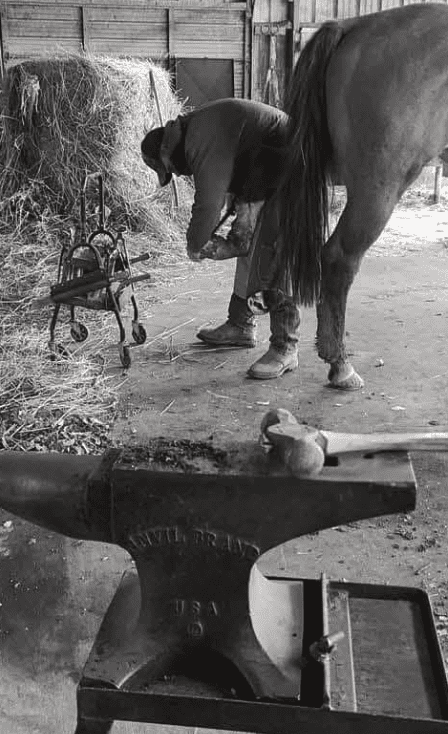
He travels from ranch to ranch with his “rig,” equipped with a grinder, anvil, a propane-powered gas forge, and a cover where nails and metal strips are stored. Previously, Strait hand-forged all of his shoes, however he said it was an unnecessary stress on his body. Now he opts for ready-made shoes that he adjusts for a custom fit.
“One of the things that I love about my industry is all the fascinating stories; the more people you talk to, the more stories you find.”