At 10 years old, Russell Matheney began cutting his hair. Up to that point, he and his brother received a buzzcuts by their Dad. Old enough to want a “style,” Matheney took on the task himself.
“In fourth grade, my brother shaved my head terribly,” he said. “It was patchy and I never let him cut it again. I started doing it myself.”
Roughly 20 years later it would become his career. One he took on after imagining that path in a dream.
“I never saw this for myself; I’ve done so many things. Even though I cut my own hair and friends’ I never thought about being a barber,” he said. “But once I got into it it’s like, ‘Why didn’t I do this sooner?’”
He served in the Marines before taking a job in supply logistics in his home state of Ohio. In 2013, he moved to Kansas to be near his then-wife’s family and worked as a flatbed dispatcher before switching to child services, working for Head Start, then providing building maintenance on Fort Riley while attending Manhattan Christian College for pastoral studies.
Then he dreamed about being a barber. Using his VA funds – and maintaining his full-time job – he began training to cut hair. In Kansas, one of the main differences in being labeled as a barber means the ability to wield a straight razor – a goal he was adamant in reaching. He also wanted to display barber poles in the front of his shop.
That meant first getting licensed as a cosmetologist – at the time, Bellus didn’t offer a barbering program. In 2016 he opened R Cuts in Wakefield; he specifically chose the name “cuts” while waiting on the barber certification.
For six months, he maintained the job on post and cut hair whenever he was able.
“At the beginning, I had to be willing to be in the shop any time someone wanted a haircut. There was no way that I was going to fail; it was not fun,” he said. Ultimately, he realized the schedule was taking a toll on his three daughters, who hung out in the shop while he gave haircuts.
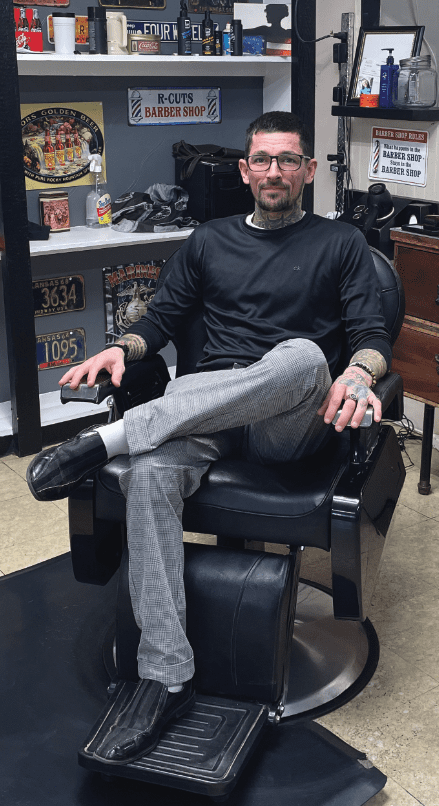
“It took me a while to realize that time with Dad and quality time with Dad are two different things,” he said, which led him to start working in Clay Center in 2020. Until 2021 he maintained a presence in both towns, until sticking with his current space at Lincoln Avenue Salon.
Then he spent three months working in Topeka, earning hours toward his state board; he said it was a stint of giving haircuts for free. But at the end, he was able to obtain a status of a licensed barber. The state board took place on two live models with a large audience, including judges who walked around while he worked.
“It was stressful, but I think that pressure was something to get used to.”
Like when he cut the hair of a high school coach in Manhattan in front of 1,700 students.
“It’s been pretty amazing since Deb and I partnered,” he said of the Salon’s owner. “I averaged 20 haircuts a day within a year of being here, busier days are 35 and sometimes 40.”
His personal record took place two years ago when he did 104 haircuts in two days on a unit of Marine recruits in Salina.
“They have to have a 0-3 gradual fade with a fresh cut every week; they had been training a month without cuts. I was set up in an airplane hanger and Top Gun 2 had just come out, so that was cool.”
Now homeschooling his kids, he works mornings then returns for afternoon customers.
“Usually I work six hours a day, sometimes it turns into nine. If I have time and people need it, I stay,” he said. “Then there are days where it’s really slow and I just go home. I’m grateful to have clients who understand the situation at home. There are times I need to be in six different places at once and you can’t really do that.”
Since he opened, he’s also adjusted services to strictly haircuts and shaves.
He now has regulars who come in from out of town. Others come from southern Nebraska or stop in for a cut when they visit family from out of state.
“It’s mostly men and kids but I have women clients too,” he said. That includes long cuts, as well as women from all walks of life who want a tight-cut fade.
“A lot of women choose to go short. Most women don’t want to take another woman’s hair; I’m not afraid to shave it completely bald if that’s what they want.” Overall, he said that’s his biggest gaffe. “I have to watch out because I can take somebody too short; I have to be careful.”
One of the biggest learning curves, he said, was learning to work with different types of hair, especially when it comes to fades.
“They don’t teach you fades; I had to learn them myself.” Now he goes off feel, managing coarse, straight, and curly hair types. “I’m actually colorblind, which helps, I can see dimension and depth in ways that most people can’t.”
After a professional career of working with kids, they remain some of his favorite clients today. He said each one is different, while some like to talk with him.
“I let the kid decide, if they don’t want to talk I don’t make them. Quiet haircuts kind of bother me, I tend to talk when I’m nervous.” He can also work quickly, which he said is ideal for a kid who’s wiggly or nervous about the cut.
“I do good with people, I help them get comfortable and then I move pretty fast.”