Unlike residential value, which is determined based on sale price and local market changes, agricultural land is determined by income value.
This keeps landowners from paying high taxes on land that cannot be used as income. This is called the modified income approach. It includes factors like yield values, landlord share, input cost (how much it costs to put the crop in the ground, including average price of equipment or technology), and the percentages of which crops are bring grown in the county.
In addition, these values are determined by an eight-year rolling average, on a two-year delay. For instance, 2025’s ag land values are prepared from 2016-2023 data.
“It’s a big window,” said County Appraiser Danny Mesalles. “I think the state’s thinking is that it modifies it less and not as aggressively.”
This comes to light as 2025’s ag land values dropped by 6% in Clay County, accounting for about $2 million. That means recent drops comes either from a profitable year in 2015, a lesser year in 2023, or a combination of the two.
However, other counties saw far larger decreases. Riley and Republic counties dropped by 7%, Marshall by 9%, while Haskell County was hit the hardest at a 41% drop. Greeley dropped by 35%, Kearney by 33%, and Stanton by 30%. However, Hamilton County, which is bordered by these three, remained even.
The entire county’s appraised value is $769,297,090 for 2025, which has almost tripled since 1998. Mesalles said the biggest contributing factor is new construction, which puts more value back into the county.
“It’s increased every year and a lot of people ask ‘Is my house ever going to be valued much less?’ But I haven’t seen it yet,” he said. “At a certain point you wonder if it will slow down but new construction adds to total value every year.”
Annually, Mesalles receives numbers from the state and applies them to each parcel of land. That includes the four types of land with a variation of 40 types of soil. For instance, sand vs. silt. vs. clay, its slope, and the chance of flooding.
Each of those factors changes how much tax is charged to an ag land owner, which can range between a value of $10 to $566 for an acre of non-irrigated, $10 to $569 for an acre of irrigated. $10 to $297 for pasture/tame, and $10 to $220 for pasture/native.
(Per type on average per acre, non-irrigated went down by $41 between 2024 and 2025, irrigated down by $69.94, tame up by $13.86, and native up by $5.57.)
“We don’t hear from them when values go down; we hear from them when values go up,” he said. “Which is understandable. The way I see it is like a big piece of pie; farmers used to, when values were high, had a bigger piece of the pie. Now values are shrinking. Their piece is smaller and residential and commercial are having to pick up because there’s a loss with contributing higher residential and commercial values.”
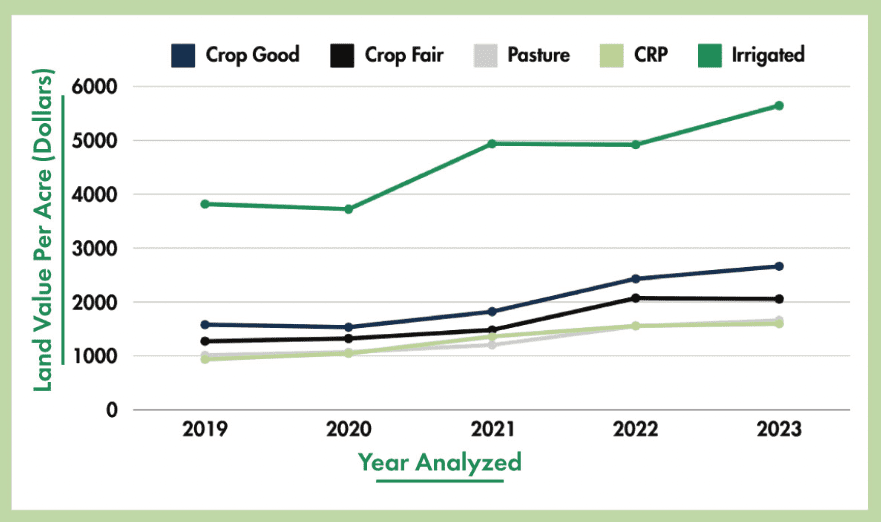
Chart left: Kansas agricultural land has had years of rapid increases in income value. These numbers are determined by the Kansas Department of Revenue’s Kansas Department of Revenue’s Property Valuation Division (PVD)