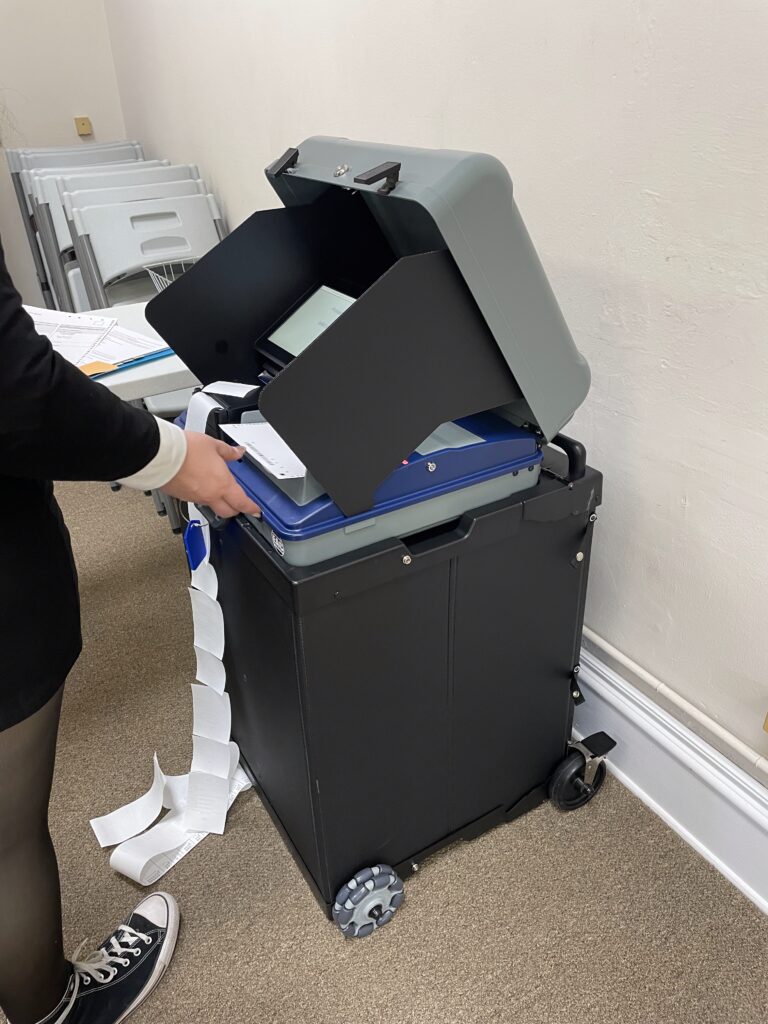
This year, Clay County debuted new voting machines for the November 4th general election. A total of 11 machines – six regular and five handicap accessible – are owned by the county.
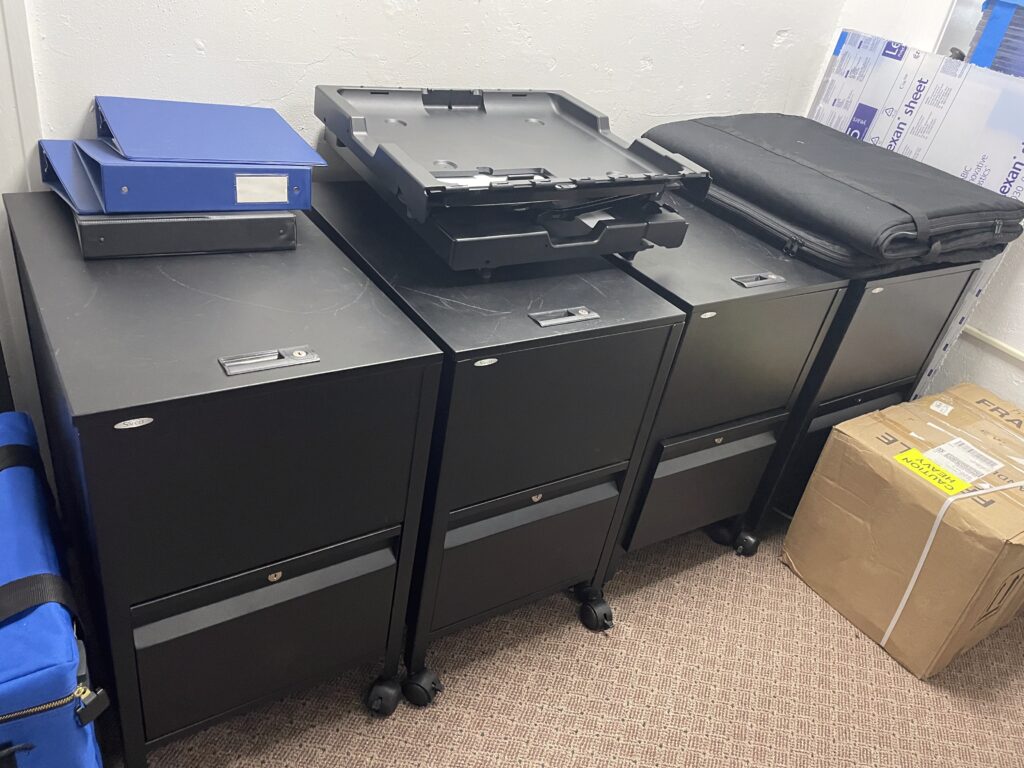
When not in use, they are kept under lock and key and camera surveillance. Anyone who enters signs in on a log sheet, said County Clerk, Kayla Wang.
Meanwhile, the machines are transported in wheeled tote boxes, also equipped with locks, while the large box that ballots feed into contain two locks – all to keep ballots safely stored away.
“We try to be as secure as we can and I’m very proud of my workers and my girls,” Wang said. “They tell me I run a tight ship.” She added that most security features were funded by a grant.
Along with Wang, three full-time employees cover the office; all work months in advance to prepare for the election. Ballot information is sent to a company, while the Clerk’s office proofs and review multiple times before they are ordered. Wang said she has requested as many as six proof sheets before signing off.
On election day, the staff works 16-17 hours, setting up by 6 am, and finishing up ballot counts at 11 pm to midnight. They are joined by a list of trained volunteers who hand out ballots, man polling stations, and feed mail-in ballots.
Machines and ballots are driven to polling locations via a former police panel van owned by the county.
“We don’t need anything fancy, it still runs,” Wang joked.
Wang said the new machines are twice as fast as the previous machines and will be placed at two polling locations in Clay Center, at the Clifton American Legion, Wakefield Methodist Church, and within the Courthouse itself.
The machines are programmed to notice errors and allow the voter to adjust so their ballot is still collected properly. Once all ballots have been collected, employees run a report, which is stored on a flash drive. Each drive is put into a single computer in the Courthouse, which does not have Internet access.
“That’s a phobia of people,” Wang said. “But they don’t have any outside access and there’s no way to identify each ballot.”
Machines also print out the number of ballots and voting tallies, which have to match by manual count.
“Once or twice it’s been off but we have found the reason,” she said. “Either a spoiled ballot or a person walking in with a mail-in ballot and fed it to a machine before they could be stopped. There’s enough steps that we can figure it out quickly.”