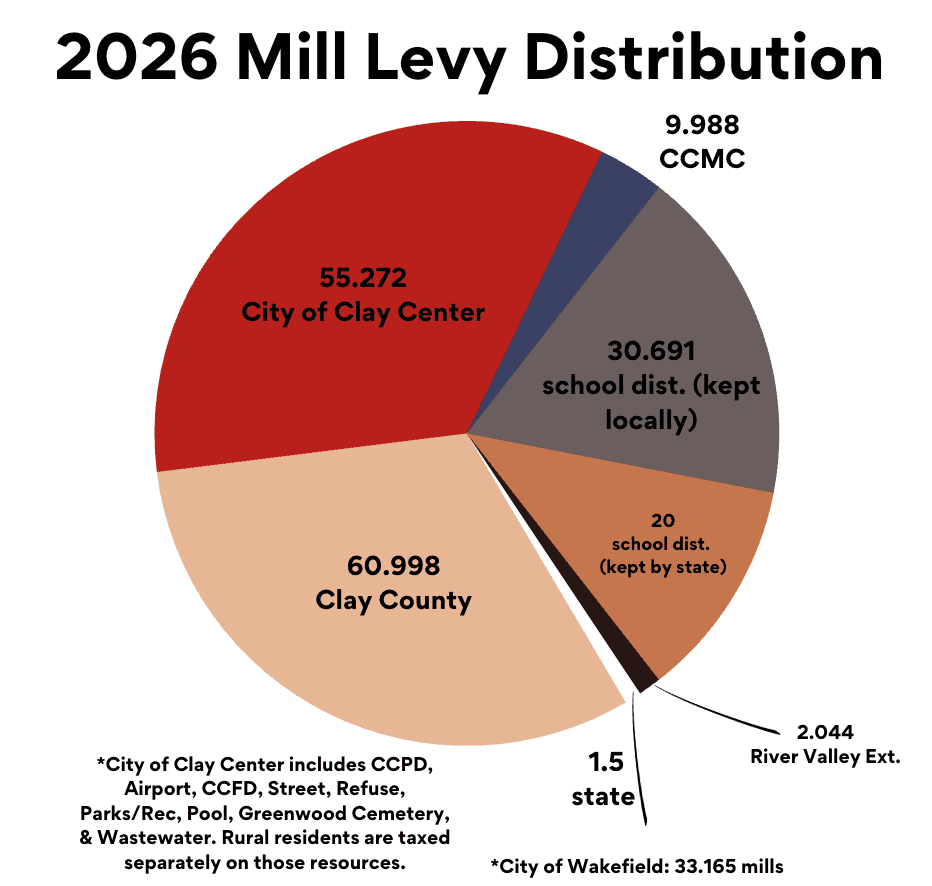
In August, tax statements went out to Clay County residents with proposed budgets for taxing entities.
Annually, County Clerk, Kayla Wang provides tax statements for each property in the owner. On the 15,000-some-odd statements, each lists what the owner will pay toward a public entity. (The city, library, fire department, cemetery, school district, and more.)
Long before those statements can ever be mailed, there are months of research and data that go into each section.
Third, those numbers come together. The total property value is divided by 1,000 to determine the mill levy/millage rate. Then the entity’s total budget is divided by mills and assigned to taxpayers, who pay on the value of property that they own.
Basing taxes off of value is called an ad valorem tax and means that each resident pays based on the value of their residential property. In other words: more value = more taxes.
It’s a process that’s so complicated and tedious that the majority of the public doesn’t know how it works, Wang said.
It includes all cities in the county, USDs 379, 224, and 334, 32 fire departments, River Valley Extension, Clay County Hospital, watershed districts, and 74 cemeteries. (Greenwood Cemetery and Clay Center Fire Dept. are funded by the City of Clay Center.) It’s based off a home’s address, meaning that a Clay Center resident will pay Clay Center taxes; a Green resident will pay toward their designated cemetery and fire district, and so on.
Next, Wang does all the math by hand.
“I may be old school, but I feel a lot better when I know they match,” she said. “It’s quite a process. It’s very complicated to set up a levy and it doesn’t just happen fast.”
To make it more complicated, they determine which services each property owner pays into based on address. For instance, someone living in Wakefield won’t pay taxes for the city of Green, and so forth.
In total, there are 204 taxing districts, or 204 combinations for which entities Clay County residents pay.
Changes in 2025 Budgets
The document outlines 2024 budgets, shows what the RNR – revenue neutral rate, or last year’s equivalent, then compares it to the 2025 budget. It also breaks down those numbers per address and shows the taxpayer how much of their dollars go to which entity.
After having federal/state funding cut by $450,000, taxes toward USD 379 went up 10% ($330,726), with capital outlay and general funds dropping by less than 1 % each. The City of Clay Center went up just .14%, while the county budget jumped 10.5% with $918,707 more from 2024’s budget.
The latter includes a mill hike of more than five to meet this difference. However, it also comes at a time where agricultural land tax income has tanked.
“It’s pretty tough to hit RNR,” said County Commissioner, Jerry Mayo. “It was especially tough this year because some things went backwards in valuation. That’s never happened before that I remember.”
Just like homeowners pay taxes on the valuation on their property, the same goes for those owning ag land. There are four categories, including irrigated, non-irrigated, native grass, and tame grass. Additional classifications may be attributed, said County Appraiser Danny Mesalles, for instance, native grass may also be waste.
This year, agricultural land in Clay County went down by 6%, a rate set by the state. In total, that accounts for an almost $2 million loss in tax revenue for the county.
With farmers paying less in property taxes, those funds must be made up elsewhere.
“Budgets were cut to make up for it; we cut budgets really close, but it’s got to happen,” Mayo said. “Those are services we need.”
Mayo said the biggest expense is the workforce, which also requires skilled employees.
“It’s getting harder and harder to get people,” he said. “It takes some training; you can’t just jump in and do the job.”
Supplies and asphalt fees also went up, said County Clerk, Kayla Wang.
“This year they called department heads into a staff meeting and asked every one of us if there’s any room to cut,” said County Clerk, Kayla Wang. “Mine is pretty walk-the-line now; I don’t get much of a budget, but they did cut some. They worked very hard to do this.”