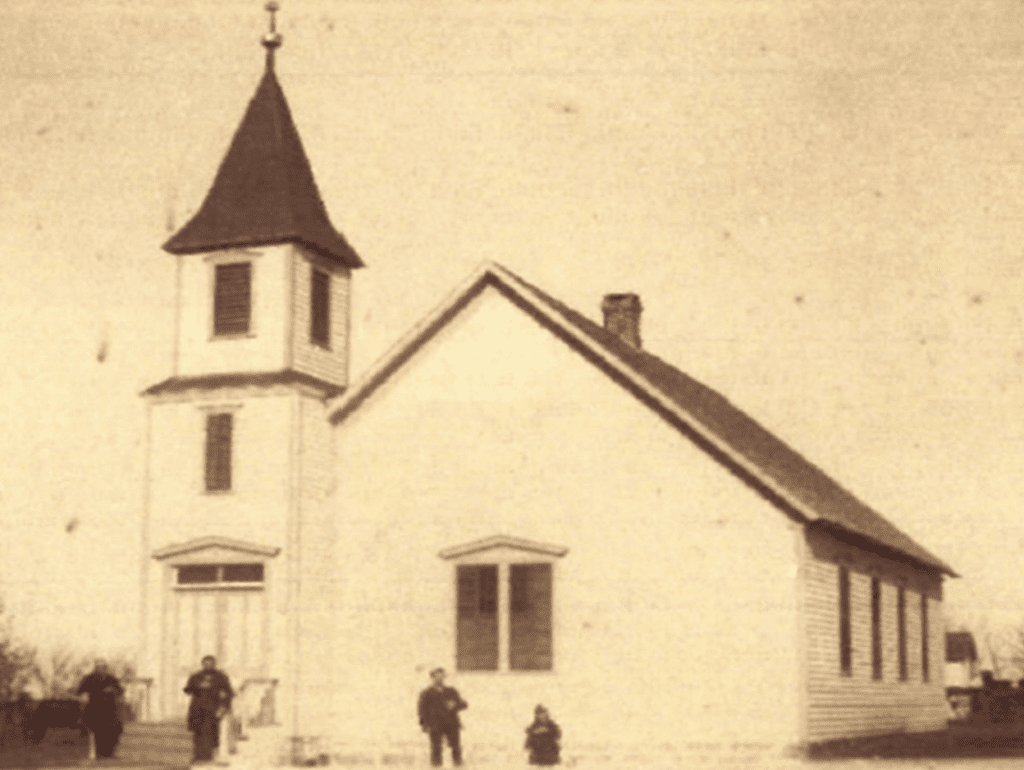
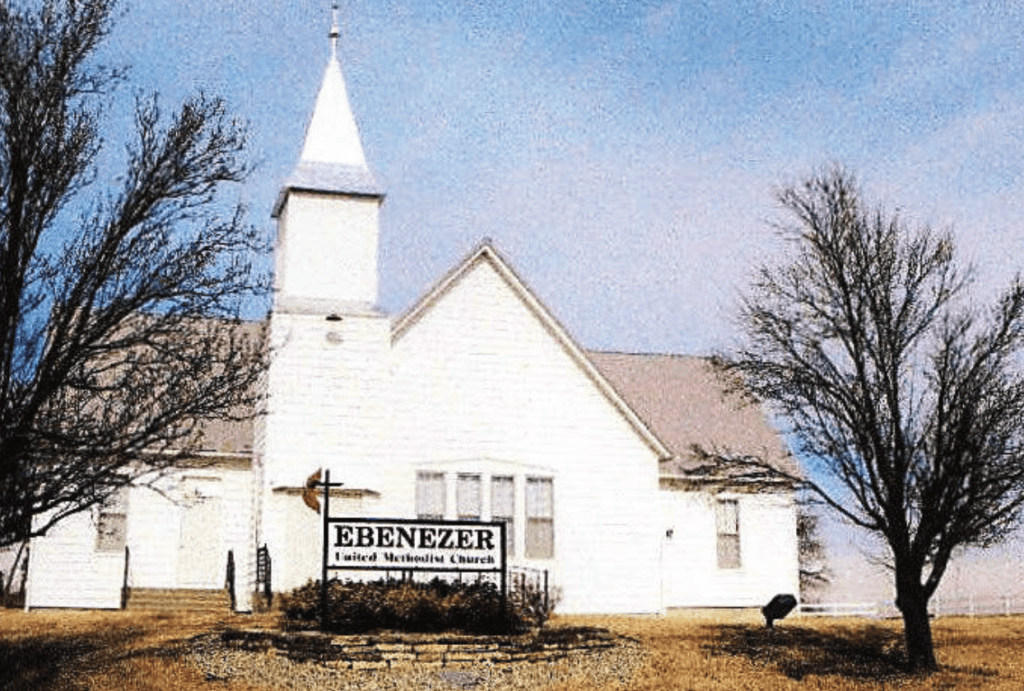
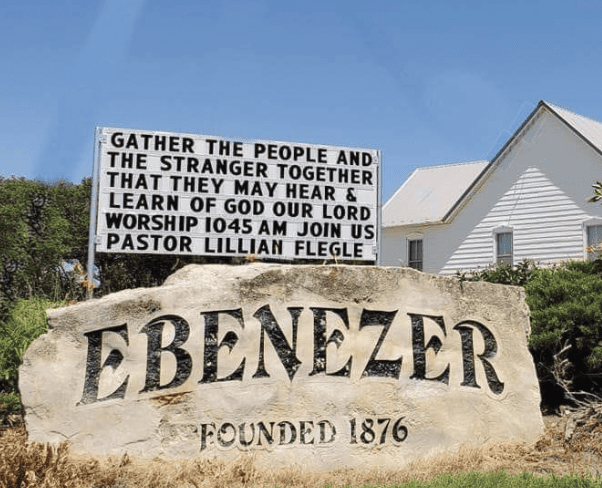
On February 15th, the Ebenezer United Methodist Church will celebrate its 150th anniversary. They will celebrate with a service at 10:45 am, followed by fellowship and lunch.
The church is located six miles east of Clay Center at 2101 18th Road Clay Center, KS.
A precursor to the church began with the Ebenezer Society, which was founded by early area settlers, like John Klein and family, arriving in 1869, Jacob Funk, the families of David and Mike Hofmann, arriving in 1873, and the George Schmidt and John Schurle families in 1874. At this time, families built houses made of stone and logs, which had a roof of dirt and gravel, which leaked in the rain.
As the Ebenezer Society grew, attracting more German settlers. They enlisted a preacher and began the church in 1876 in the home of David and Barbara Hofmann. There were 12 church members at that time. The first year of giving, including overhead and pastor’s salary of $300, totaled $826. (Just over $9,000 and $25,000, respectively, in 2026; by 1950, annual tithes had grown to $17,876, or $240,415 today.) At this time, membership had grown to 38 people.
In 1876, an acre of land was purchased from Jacob Heer for $10 ($302.92) and a year later, a state charter was granted. A 20’ x 30’ building was erected for $600 by Christian Hagenbuck and Fred Schurle ($18,175.). At the dedication, it was named Ebenezer, meaning, “Hither to hat the Lord helped us.”
The first pastor was John Ehrsam, who helped found the church. A military veteran, Ehrsam partnered in a vinegar factory, which is what he did in his home country of Switzerland. With the influence of another Methodist preacher, Ehrsam received his Exhorter’s license in 1876.
The Society experienced their first death in 1874. Because there was no cemetery, Jacob Heer and wife donated an acre of their land for burial ground, where Philip Waldvogel was laid to rest.
Church lore says an additional five graves lay behind the church, four of which are marked. However, no records state the specifics of who was laid to rest or how they ended up next to the church.
Five years later, the church hosted its first nuptials, when George Schurle and Rosina Raber were wed in 1879. And in 1886, the first organ was installed, which was played by Barbara Hofmann.
The first addition was laid in 1890, again by Fred Schurle, along with others from the church.
Controversy prevailed in the 1880s, as Reverend Fiegenbaum pushed for children to attend church on Thursday afternoons, which interfered with school. Teachers protested, but Fiegenbaum got his wish.
For the first 40 years, German was exclusively used for all services. After that, half of the services were conducted in German and the others in English until 1940 when English was the church’s exclusive language.
The church was again expanded with a west annex of 18’ by 26’ taking shape in 1906. An east annex of the same size was placed in 1928. By 1935, the church peaked with 234 members, and in 1939, electricity was added. Two years later, the entire church was lifted from its foundation as a basement was added. The entire thing was rededicated on April 6, 1941. Improvements continued to be made, such as drilling a water well, making the facility handicap accessible, and remodels.
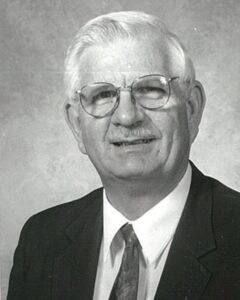
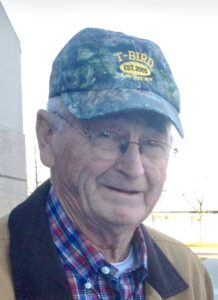
Church member, Arvin Hofmann’s great-grandfather was a founder of the church and remembers attending services since childhood. Hofmann’s sister, Eloise Sanneman also still attends.
Growing up, there were two other students in his grade and the trio still keep in touch.
“We’ve been friends all these years.”
He especially remembers gathering during WWII, when he said the church was the “center of the community” and a form of social entertainment.
“Gas was rationed and no one was traveling very far; the church was the local gathering spot.”
In addition, Hofmann has also served as a soloist in the church since freshman year of high school.
“My uncle died in 1950 and I sang the Lord’s prayer because it was a request; from then I wish I’d have kept track of how many funerals I’ve sang at, it’s well over 100.”
The church was also a place for tradition, like the Christmas Eve service, which Hofmann said was held annually until 1983, when an arctic blast forced them to postpone. It was also the snowiest year in Kansas history.
Another lifelong member, Kenneth Schurle, has roots back to Ebeneezer’s beginning. He too said he remembers holiday services, which included Thanksgiving, New Year’s Day, as well as mid-week services.
“Going to school and going to church, that was the two things we did,” he said. “We did play some ball too.”
Through 1990, a total of 28 ministers served the church.