The U.S. Mint ran its final production of pennies in Philadelphia after 232 years. The coin’s retirement has been planned due to rising costs of production and lack of use. By its last round, it cost 3.7 cents to make each 1 cent coin, totaling a fee of $56 million annually. In addition, 41% of Americans don’t use cash, according to recent studies, a number that’s up from 29% just seven years ago.
The last order of pennies was placed by the U.S. Treasury in May of 2025 2025, an announcement that caused a ration on penny allotments from Federal Reserve Banks.
Uncle Sam isn’t the first to do away with their one-cent currency. New Zealand began phasing out lesser coins between 1990 and 2006, Australia stopped one and two-cent coins back in 1992, and Canada followed suit in 2012.
A bill to do away with American pennies was first introduced in 1990 and has been revisited three more times in 2001, 2006, and 2017. However, it wasn’t until President Trump ordered the halt in February of 2025 that the official kibosh was placed on Abe Lincoln’s coin tenure.
Existing pennies will remain in circulation, with 114 billion, or about 700 per person, in use.
It is expected that merchants will round cash payments to the nearest five cents (up or down), while online or card payments will still include the exact cent. A proposed bill in Congress suggests putting that into law, though it has not yet passed.
Anyone with existing pennies can spend them or deposit at a local bank. It’s also worth looking into any key features, as some pennies could be of value.
MVP: Most Valuable Pennies
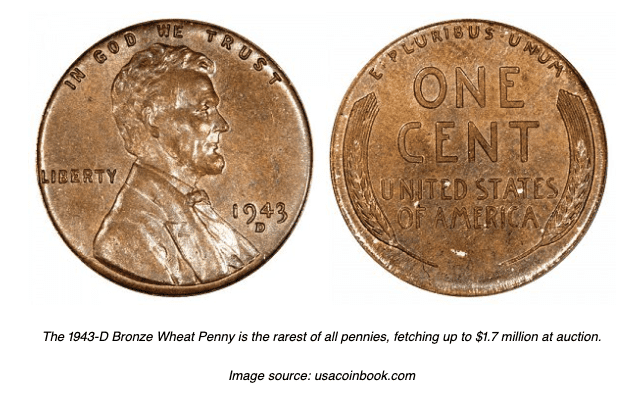
The most valuable pennies are the 1943 Copper Lincoln Wheat Penny, worth over $1.7 million. (One was last sold for that price in 2010, which would be nearly $2.26 million in 2025 dollars.) During WWII, copper was used toward military efforts and was limited for stateside use. This caused the U.S. Mint to make pennies out of zinc-coated steel, however, 20-30 copper pieces were accidentally made.
The 1944 Steel Wheat Penny is another rarity. About 1,000 were made and can be easily recognized by their silver appearance. Today they’ll fetch up to a half-million.
Next, the 1955 Double Die penny is worth up to $2 million. It gets the name from a printing error where LIBERTY and IN GOD WE TRUST overlap. Even versions in poor condition can go for more than $50,000.
In 1909 the Lincoln penny made its debut; prior to this, a generic person had adorned the coins. This was the first time a U.S. coin featured a real person. It was designed by Victor David Brenner, who left his initials – VDB – on the back side of the penny. Due to backlash, the mark was soon removed, but 484,000 had already been made. Today a VDB Lincoln can go between a few thousand up to $750,000, depending on condition. There are believed to be less than 200 VDB Lincoln Pennies.
The Indian Head/Double Liberty penny from 1873 is another sought-after coin. As its name suggests, LIBERTY is printed twice across the headdress band due to misalignment during the minting process. Any Indian Head penny is considered rare and potentially valuable, though this one can fetch between $10,000 and $300,000.
Then there is the 1922 No D Penny, which is missing the “D” from Denver, where the coins were minted. A worn die left coins without their signature mark, adding value to the rare fine. This lot can fetch up to a quarter million each.