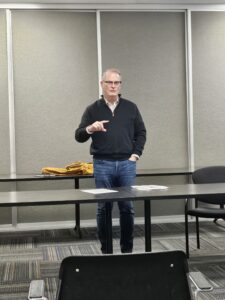
By Ron Wilson, director of the Huck Boyd National Institute for Rural Development at Kansas State University/Image: Georgia Zavala
Imagine traveling across Kansas and coming unexpectedly on a bustling city of 20,000 people. That would be larger than 604 towns in Kansas today.
Such a city is believed to have existed hundreds of years ago at what is now Arkansas City, Kansas. Modern anthropologists and archeologists have discovered artifacts from this site, sometimes called Etzanoa. or the Great Settlement.
Georgia Zavala is director of the Etzanoa Conservancy in Arkansas City. She grew up in Wichita and earned bachelor’s and master’s degrees in anthropology at Wichita State. In the course of her studies, she participated in an archeological dig near Ark City at an ancient site known as Etzanoa. After the citizens of Arkansas City formed the Etzanoa Conservancy, Zavala became director.
“Etzanoa is an ancestral Wichita native village site which is believed to have been active from around 1450 to 1700,” Zavala said. “In 1601, the Spanish explorer Juan de Onate came through this region.”
The records kept by the Spaniards reported that they came upon a very large native settlement.
“This village was absolutely massive for the time,” Zavala said. Native people were living 10 to a lodge.
“The Spanish started counting houses and finally stopped when they got to two thousand,” Zavala said.
On that basis, archeologists believe the village had a population of 20,000 to 30,000 people. The Spanish would later term it “the Great Settlement.”
When the Spaniards asked a native captive the name of this village from which he came, he replied “Etzanoa.” Having not discovered gold, Onate’s expedition left the region.
By approximately the year 1700, the village of Etzanoa dispersed for reasons that are unclear. Remaining residents were absorbed into the Wichita tribe.
Modern day archeologists have found thousands of artifacts in the region. According to local lore, in 2017 a teenager near Arkansas City found a cannonball that was linked to a battle that took place here in 1601. Local researchers then used this artifact to pinpoint what is believed to be the location of Etzanoa.
“The Etzanoa Conservancy is a non-profit organization with the goal of preserving Etzanoa and sharing its history with the public,” Zavala said. “We are working on developing a visitors center, which should open in June 2026.”
Currently the Etzanoa Conservancy offers tours by appointment. “We’ve had visitors from Washington to North Carolina,” Zavala said.
The tours include a documentary film, a visit to Chief Lodge where guests can view man-made mounds dating back to the 1600s, and a stop at a local church camp called Camp Horizon.
“At Camp Horizon, we can view the confluence of the Arkansas and Walnut Rivers and point out the general vicinity of where these people would have been,” Zavala said.
Camp Horizon is located east of town between Arkansas City and the rural community of Silverdale, population 61 people. Now, that’s rural.
“Everyone gets so excited when we have events,” Zavala said. “The people here are so nice and welcoming. It’s amazing how supportive the community is.”
In the 1990s, construction of a nearby highway bypass unearthed a treasure trove of artifacts in addition to those that have been located routinely.
“So many people have shared the artifacts they have found in their backyards or farms,” Zavala said. These include pieces of stone tools, animal bones, ceramic pottery and more.
“If people hold an artifact and realize that someone held this same thing 400 years ago, it’s a sort of connection,” Zavala said. “I want people to get excited and learn about this massive piece of history in their backyard. I want this to be accessible and for people to gain an appreciation of history and an acknowledgement of the land we live on.”
It’s time to leave what once was a city of perhaps 20,000 people, now lost to the mists of time. We commend Georgia Zavala and others of the Etzanoa Conservancy for making a difference by preserving and sharing the history of this lost city.
It must have been a Great Settlement.
Audio and text files of Kansas Profiles are available at https://www.huckboydinstitute.org/kansas-profiles. For more information about the Huck Boyd Institute, interested persons can visit http://www.huckboydinstitute.org.