By Ron Wilson, director of the Huck Boyd National Institute for Rural Development at Kansas State University/Image: John Fitzthum
“History was made here today.”
That’s how one person described the test flight of a drone that delivered a piece of medical equipment to a rural hospital nearly 30 miles away. It was a pioneering effort to see how unmanned aircraft can benefit rural hospitals and patients in the future.
John Fitzthum is CEO of the northeast Kansas Community HealthCare System that participated in the test flight. Fitzthum and his wife are from Wichita. They went to college in Colorado and lived there for years before returning to Wichita.
“We moved back to Kansas because we wanted to raise our kids like we were raised,” Fitzthum said.
In 2014 he joined the Hays Medical Center. In March 2025 he became CEO of the Community HealthCare System, headquartered in Onaga. “I’m loving every minute of it,” he said.
Fitzthum was approached by Lukas Koch of Kelly Hills Unmanned Systems and Brian Kassin of the Kansas Department of Transportation about a new project: A test flight of a drone to transport medical supplies.
“The hair on the back of my neck stood up,” Fitzthum said. “We’ve been talking about the need for this type of system for years.”
Hospitals typically utilize a pneumatic tube system that quickly and easily transports lab samples, medications and documents between departments. But what about when medical facilities are located in different towns?
“For years, we’ve talked about the need for a tube system in the sky,” Fitzthum said. “We have multiple clinics and long term care homes that we’re transmitting items to daily using a sophisticated courier system.”
What if a drone could be used to deliver those needed materials? KDOT and other partners wanted to explore the possibility. They developed a plan for a test flight.
With support from K-State’s College of Aerospace and Technology in Salina and an autonomous aircraft company named Pyka, a flight plan was developed and approved by the FAA.
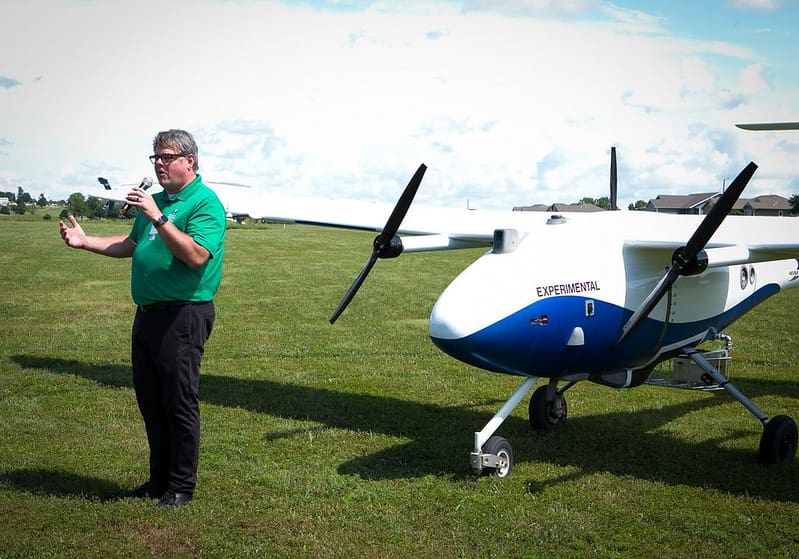
On Aug. 12, 2025, a lightweight unmanned Pyka aircraft took off from the Heinen Brothers Airfield south of Seneca with a payload of an Automated External Defibrillator as a sample.
“The aircraft automatically followed the flight plan,” Fitzthum said. “There was a technician on the ground with access to remote control if needed.”
Approximately 30 minutes later, the drone made a flawless landing and delivered its payload to the airport near the hospital in Onaga. It was the state’s first-ever long-range drone delivery of medical supplies.
Community HealthCare System serves multiple rural communities, with facilities in Onaga, St. Mary’s, Westmoreland, Holton, Frankfort, Centralia, and Corning, population 212 people. Now, that’s rural.
“We need to be able to transport labs and supplies safely and quickly between our facilities,” Fitzthum said.
“Let’s say someone suffers a snakebite and we need a unique kind of anti-venom from Wichita or Kansas City, or maybe the situation requires additional units of blood,” Fitzthum said. “(Drone delivery) can create a real life-saving opportunity.”
“In rural Kansas, where distances can make the difference in timely access to critical care, the ability to move life-saving supplies by drone is truly a game changer,” said Travis Balthazor, who works at the Kansas State University Salina Aerospace and Technology campus.
“Our mission is to keep our patients closer to home,” Fitzthum said. “When I mentioned this to our medical staff, they pointed out that sending a sample by drone could enable us to do surgeries here that we couldn’t do before.”
This was an initial and successful experiment.
“We need to do lots more testing to assure safety and protect patient health information, but we hope to continue to showcase how this can serve rural America,” Fitzthum said. “In the long run, I hope this technology can help attract more youth back to our rural communities.”
History was made today, said one participant following the state’s first long-range drone delivery of medical supplies. We commend John Fitzthum and all those involved in this project for making a difference with their innovative approach to transporting rural medical supplies.
I’m glad this project passed the test with flying colors.
Audio and text files of Kansas Profiles are available at https://www.huckboydinstitute.org/kansas-profiles. For more information about the Huck Boyd Institute, interested persons can visit http://www.huckboydinstitute.org.