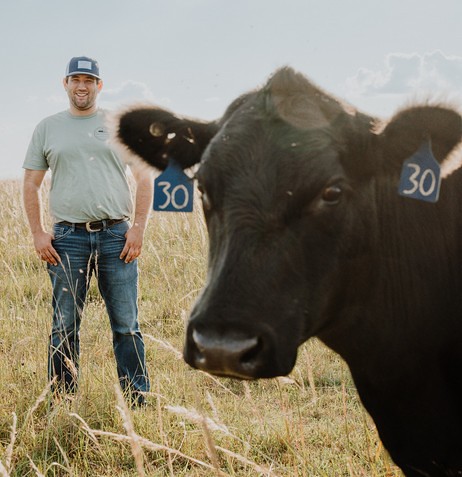
By Ron Wilson, director of the Huck Boyd National Institute for Rural Development at Kansas State University/Image: Thomas Eisenbarth
How does a wheat plant survive the Kansas winter? Among other things, it must be well-grounded in the soil.
What about the farmer who plants and grows that wheat? In order to withstand the stresses of modern times, he or she must also be well-grounded in a supportive environment.
Today we’ll meet a young Kansas farmer who is working to assist farmers with mental health issues by grounding them with the support they need.
Thomas Eisenbarth is the founder of Grounded Ag, a mental health assistance enterprise focused on agricultural producers and families.
Eisenbarth grew up on the family farm near Onaga, earned a degree from Kansas State University in ag technology management, and returned home. He is now a farmer and rancher in Onaga while also serving as the precision agriculture instructor at the Highland Community College Western Center at Baileyville.
Baileyville is a rural community of 182 people. Now, that’s rural.
Eisenbarth is familiar with the intense stresses that farm families can experience. In 1997, his uncle took his own life.
“It left a lasting impact,” Eisenbarth said. “As painful as that experience will always be for me and my family, it put it into to my heart to turn that pain into purpose.”
After coming back to the farm, Eisenbarth experienced intense pressures himself. He finally went to see a therapist and realized there was great need for mental health outreach in the ag community.
Eisenbarth became a certified Mental Health First Aid provider. He founded Grounded Ag to provide public speaking, training, workshops, writing and consulting to help producers and communities navigate these difficult issues.
“Mental health and agriculture seem like opposite ends of the spectrum,” Eisenbarth said. “Mental health sounds like taking a deep breath, peace of mind, taking care of one’s physical health, and simple rest. Agriculture can be just the opposite: Stress, long hours, no sleep, and mental chaos. The two don’t mix.”.
Often such conflicts are true for family dynamics in farm families as well. “You might have the two extremes,” Eisenbarth said. “There’s the grandpa who was raised by parents who survived the depression, and the youth who are totally immersed in technology. It’s a generation gap.”
Eisenbarth sees the big picture of society. “In a way, we’re the most connected that we’ve ever been, but we’re the most disconnected too,” he said.
In 2025, his partner, Rachelle Coe, founded Wild Haven. That is a rural women’s initiative rooted in healing and growth. Its goal is empowering women to embrace their worth, resilience and leadership potential. Both Coe and Eisenbarth are actively sharing their experiences with farm and rural groups.
Their down-to-earth experiences relate with rural audiences.
“The nervous system is like a tractor,” Eisenbarth said. “You’re not flipping switches, you’re adjusting dials.”
This means that a problem is not fixed by just flipping a switch, but there needs to be ongoing calibration.
“I talk about V-squared: Vulnerability and Validation,” Eisenbarth said, noting that both are essential for healing.
His message to farmers is simple: “If you think you’re the only one feeling this way, you’re wrong,” he said. “The worst thing is suffering in silence. You are not alone.”
In 2025, Eisenbarth was selected for the Kansas Farm Bureau Rural Minds Matter Young Advocate of the Year award.
“I’ve lived the tension between agriculture and mental health, and I know firsthand how easily isolation and burnout can take hold,” Eisenbarth said. “But I also know there’s another way forward. Through training, conversation and connection, we can bridge these two worlds and equip rural communities with the tools they need to thrive.”
“Help is closer than you think, and connection and conversation can save lives.”
For more information, see Grounded Ag on FaceBook.
Just as a wheat plant survives the Kansas winter, producers must be well-grounded as well. We salute Thomas Eisenbarth and Rachelle Coe for making a difference by helping farm and ranch men and women find support and resilience in times of stress.
Such efforts can result in a healthy harvest.
Audio and text files of Kansas Profiles are available at https://www.huckboydinstitute.org/kansas-profiles. For more information about the Huck Boyd Institute, interested persons can visit http://www.huckboydinstitute.org.