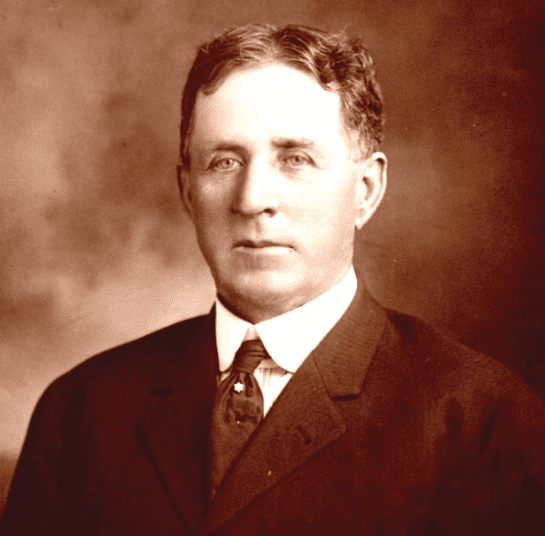
Second-generation Clay Countian, George Hanna, came to the Blaine township when he was just 9 years old. His father, John, immigrated from Ireland before moving to Illinois in 1857. George was born in Coulterville, IL in 1861, the oldest of eight children. The family settled three miles south of Clay Center on Valentine’s Day. The kids attended school in a barn owned by a local reverend.
Hanna was a prolific businessman, despite attending only two years at the Clay County High School. In 1885, George W. began making his mark in Clay Center. He went to work for the Clay Center Creamery under the management of George Morgan. George W. soon took over stock of the business and had locations in Wakefield, Garfield, Idana, Oakhill, Lasita, Miltonvale, Aurora, and Meredith. Each employed at least two men, one to work the station and another to deliver. During the hardship years of 1892-1896, George W.’s payroll remained one of the highest in the area.
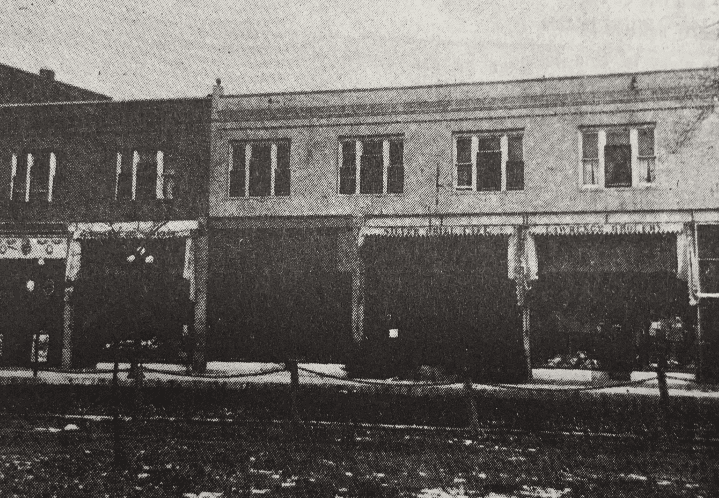
In 1900, he sold the creamery business and opened a local produce house; he also worked in real estate and insurance. The “Hanna Business Block” was located north of the Courthouse Square in the early 1900s.
In 1901, he secured the charter for Union State Bank. By the time he sold his interest in 1907, there was over $155,000 in deposits (Over $5.3 million today). That same year he secured the charter for Farmers State Bank, with deposits over $200,000 in its first year (Nearly $6.9 million). John became president of the bank while George W. served as cashier.
In 1905, he was elected mayor on the Democratic ticket and served three terms. In his second term, Hanna received all but 280 votes. During that time, he’s said to have had one of the widest impacts on the town to date. By the time his term ended in 1911, he had helped build more locations in town than any previous resident.
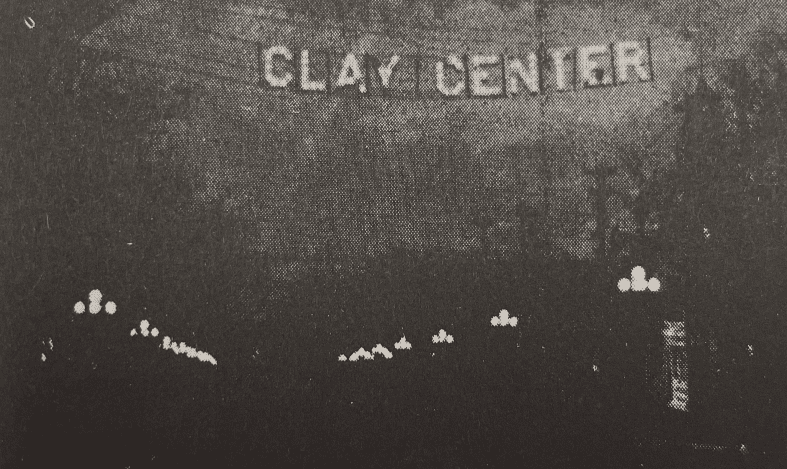
His contributions included: The Farmers’ Elevator, the electric Clay Center sign, the City Auditorium (or Chautauqua Auditorium), the Clay Center Carnegie Library, The Emmanuel Home, the Post Office, City Hall (previous building), the Clay Center Foundry, Clay County High School, and he helped expand Greenwood Cemetery and Huntress Park, where he added the electric fountain, cement walkways, and a bridge over Huntress Creek. In addition, he increased water service lines and sewage systems.
His motto was, “Let Clay Center nourish.”
He spearheaded a project to add cement crossings on city streets, removing wood and tile culverts. It was believed he had killed his political career when putting the crossings at Clark St. and Crawford St. intersections; however, residents soon realized the “high water problem” had been solved.
Perhaps most notably, Hanna is known for his involvement in the Williamson Dam issue that went to the U.S. Supreme Court, the issue on which he won his first race in a “bitter” election.
Previously, electric lines were owned privately by Williamson & Company; when they wanted to raise rates by 5 cents ($1.84), the City opposed and began what would become a lengthy legal battle in 1904. Three years later, after a municipal power plant had been approved and funded by voters, Hanna and the City Council notified Williamson & Company to discontinue their power service and remove poles and wires from streets and alleys.
Instead, Williamson & Company pursued legal action against the City. After three years, the poles were still in place. Hanna ordered an electric light pole between Grant Street and the dam to be cut down on November 15, 1910. More poles were cut down by citizens on 5th Street, and cables were cut.
The City received legal action from Merrimack River Savings Bank, Williamson & Co.’s creditor, who still held a bond on electric lights and poles. There had been a temporary injunction from removing the lines; however, the City argued it had expired, and they believed the case to be closed. The Supreme Court charged the City $17.55 ($646.11) in court costs and closed the issue. The fine was paid by townsmen in 10¢ increments. ($3.68) It was an act that named the mayor, “The best fighter in Kansas.”
The City won the entirety of the case, ruled in 1916. This allowed a municipality to take ownership of the electric plant and lines, charging 12¢ per house ($4.42) vs. the Williamsons’ proposed 17¢ ($6.26).
Around this time, Hanna was also credited for Clay Center’s “Great White Way,” which was 22 miles of lights throughout city streets. In 1913, funding was raised to add 250 lights, fed by 7,170 feet of underground cable, surrounding the Courthouse square and business streets. They shone until replaced by “The New White Way” in 1930.
When exiting the Mayor’s office, Hanna was gifted a gold watch with the inscription, “Presented to Mayor Geo. W. Hannah as a token of respect and confidence by the citizens of Clay Center, Kan., May 1911.” It was paid by local donations from the public, with a maximum per-person donation of $1. ($34.10)