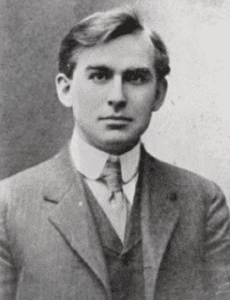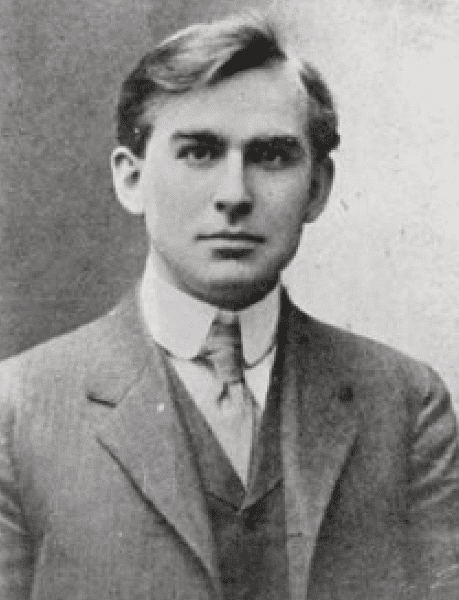
Professor Tenney Frank was one of the most prestigious Latin professors of his time. Born on the family farm north of Clay Center May 19, 1876, he was raised in the area before traveling for his education. Parents Olaf and Carrie, of Swedish descent, moved to Clay County’s Sherman Township from Kansas City in the 1870s. Olaf was linked to Swift & Co. before returning to Kansas City in 1901.
However, Tenney attended secondary school at Central High School when it was located in downtown Kansas City prior to his parents’ return.
There, Tenney won the gold medal among area students in both Greek and Latin in 1896. A year later, he earned a bachelor’s degree from Kansas University with “highest distinction and Phi Beta Kappa key.” The following year he earned a master’s degree.
Next, he became an instructor in Latin at the University of Chicago from 1901-1904. Tenney then moved to Baltimore where he became a professor at Bryn Mawr. While in this position, he taught Helen Taft, the daughter of then-president William Howard Taft.
Tenney was promoted to full professor and remained until 1919 when he became a professor at John Hopkins University. His father, Olaf, also died that year.
In 1914, Tenney wrote a 400-page book titled, Roman Imperialism.
In Baltimore, he married fellow professor, Grace Mayer, who taught medieval French literature and drama, in 1907. Grace later served a stint as a visiting professor at John Hopkins from 1934-1936. Grace also served as the VP of the Modern Language Association.
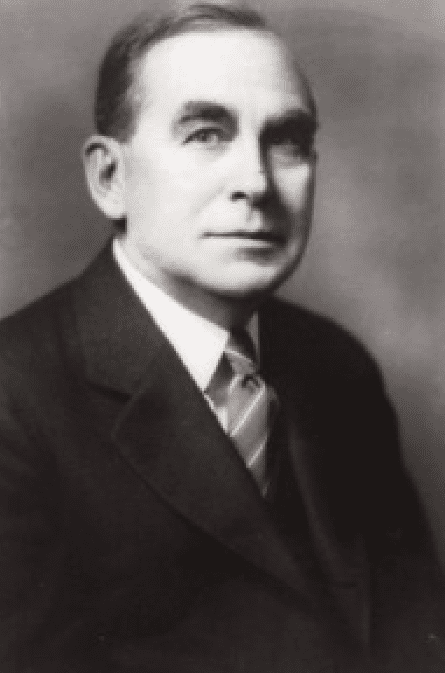
In 1937, his maternal uncle, Paul Danielson, died while helping build the Grand Coulee Dam in Washington State. He fell 70 feet to his death and remained one of 77 to die on the jobsite between 1933 and 1941. Paying 80¢ an hour, it was considered one of the best-paying jobs in the nation. $18.01 in 2026. (A three-bedroom house near the jobsite rented for $32 a month; $720 today.) In total, it employed more than 8,000 people.
He was named the first classical scholar to be elected to the Eastman Visiting Professorship, which he was fulfilling at Oxford, England, at his time of death. At 63, Tenney died in 1939 and was buried in England.
Tenney’s brother, Arvid, was also well known.
He worked for the federal government, serving with the Council for International Progress in Management, SP of the Council on National Trade Policy, executive director of the US section of the International Chamber of Commerce in New York, director of international relations for the National Association of Manufacturers, as well as running various private entities before retiring in 1956. Arvid died in 1976.
Grace returned to Baltimore, where she continued to teach at Bryn Mawr. In 1952 she was named professor emeritus of Old French. She had a heart attack at 91 years old in 1978.