In 1928 FFA was founded as a nonprofit youth organization. However, a precursor, FFV or Future Farmers of Virginia, was founded in 1925 at the Virginia Polytechnic Institute (Virginia Tech).
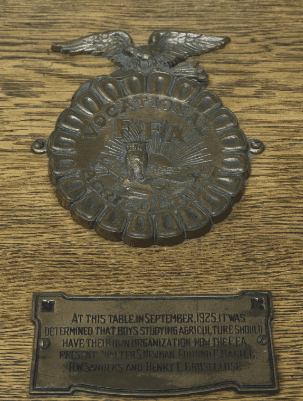
There, a group of four agriculture professors created the group as a way to provide opportunities for rural high school boys. Original focuses included vocational ag training, leadership opportunities, and confidence. The original square wooden table where these teachers sat is known as the original table and remains on display at Virginia Tech’s FFA Historical Room.
Prior to this, Senator Hoke Smith and Representative Dudley Hughes of Georgia passed a National Vocational Educational Act, which established agriculture classes in schools. This was a precursor to students furthering their ag careers in a public-school setting.
In 1926, the first National Congress of Vocational Agriculture Students gathered in Kansas City, MO for a National Livestock judging contest at the American Royal. Two years later, FFA was established in KC, MO where the first National FFA Convention was held; 18 states were in attendance.
In 1932, a charter was granted in Puerto Rico, the establishment’s first international location.
The first official chapter was created at Weyers Cave High School and three years later it was expanded into a nationwide group, Future Farmers of America.
By 1929 National Blue and Corn Gold were adopted as official colors and in 1944 it was formed into a Foundation.
However, it wasn’t until 1965 that students of color could join, when FFA merged with New Farmers of America. And in 1969, women were allowed to become part of FFA.
In 1988 the group’s name was shortened to the National FFA Organization, or just FFA. The adjustment was made to celebrate diverse ag channels, like fibers, natural resources, science, business, tech, and more.
The Jacket
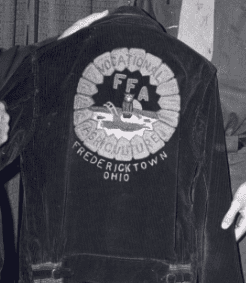
One of the most recognizable features of an FFA member is their blue corduroy jacket. It features the FFA emblem, followed by the wearer’s chapter, district, and region. Not all members have their name on the jacket, but it’s popular regionally. It is part of the FFA member’s official dress for related activities.
The jacket was created by the Fredericktown Band of the FFA chapter when Dr. Gus Linter saw such a jacket on display at a hardware store. He ordered jackets for his members and had the chapter’s information embroidered with gold thread. The jackets were debuted in 1933 at the National Convention in Kansas City and caused such a stir, they were made part of the group’s official uniform.
In 1964, the millionth FFA jacket was sold; that number doubled in 1976. Today, more than 80,000 jackets are sold each year, requiring more than 128,000 yards of corduroy. Jackets cost between $65 and $90 and a scholarship program, Give Blue, is available.
Despite the tradition, jacket colors have varied throughout the years, from blues to purples.
In 2001, however, the National Organization set out to standardize the hue. Based on historic jackets, a uniform supplier worked through Clemson University’s Apparel Research Center to both standardize the jacket’s color, fit, and emblem. The standardized jacket was made available in 2005 in Van Wert, Ohio, where all FFA jackets continue to be embroidered today.
The Creed
Adopted at the third National Convention, the FFA creed was written by Kansas native, Erwin Milton “E.M.” Tiffany. Hailing from Lyndon, Tiffany penned the five-paragraph system of beliefs.
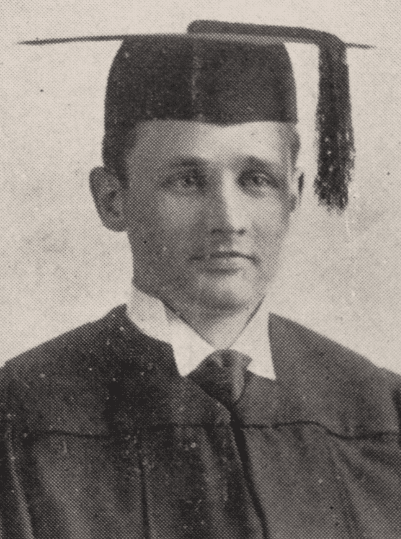
Each stanza begins with “I believe” and outlines goals of working in the industry of ag. At the time of writing, Tiffany served as an ag education teacher at the University of Wisconsin. He later returned to Kansas and worked as a high school principal. He is buried in Osage County after his death in 1949.
The Creed has been adjusted twice, both by a national board. All versions can be read on the FFA website.
Notable Alumni
There are several career paths for those involved with FFA, however, it’s a notable past among politicians and musicians, particularly country-western singers. Including: Trace Adkins, Johnny Cash, Brantley Gilbert, Toby Keith, Tim McGraw, John Mellencamp, Willie Nelson, and Taylor Swift. Actor Nicolas Cage was also involved in FFA.
Pictures: Left, an emblem on the original table that FFA was formed upon is displayed at Virginia Tech. Middle: an original FFA corduroy jacket. Above: Kansan, E.M. Tiffany wrote the official FFA Creed.
Information about the start of Clay Center’s FFA Chapter is available on page 10.