When Armond “Frenchy” Frigon saw a need, he found a way to fill it. Known for his big ideas and his big beard – he won a contest for such in the Clay Center Bicentennial celebration in 1961 – Frigon made a mark on this town in more ways than one.
A serial entrepreneur, he created revenue streams for himself by finding small opportunities, and turning them into big operations. He sold appliances, TVs, wholesale fireworks, and most notably, worked a traveling gun sales business with his wife and youngest son in tow.
A trained mechanic with WW Smith & Sons (located in the now Clay County Museum building), Frenchy decided to go into business for himself. After a short stint downtown with Frigon Motor Company, he built a location at 627 W Crawford in 1960, now the location of The Liquor Store.
Frenchy started off with selling liquor, however, noticing a need for appliances, he decided to split his business into two, with TVs and appliances on one side of the building with Frigon’s Mixer shop. With a wall down the middle, he had two side-by-side businesses. Soon he began selling guns and appliances on the west and alcohol on the east. TVs and antennas were also part of the business.
Soon, however, the gun portion of his business had taken off; Frenchy closed the alcohol sales to use that space for firearm packaging and shipping.
“He finally started selling enough guns that he would buy them from Remington and had became a dealer,” said Ray Frigon, Frenchy’s eldest son.
Needing more room, Frenchy obtained a one-room schoolhouse from the Morganville area, and used it as an addition to store powder and extra guns. An awning was added so he could load guns in the rain, Ray said. This, of course, was the other half of the success: traveling gun shows.
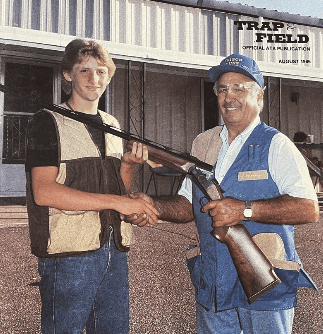
Creating a hydraulic lift, pre-loaded with display firearms, Frenchy, his wife, Arlene, and youngest son, Phil, traveled around the country to sell firearms and participate in trap shoots.
“They would leave in February and come home in October,” said Ray. “I didn’t see a lot of them during that time.”
Frenchy and Phil are both in the Kansas Trap Shooting Hall of Fame. Meanwhile, they worked by selling guns, they’d open the custom van to sell firearms at the trap shooting event. Ray said Frenchy partnered with a gun engraver to make unique or custom designs; one year they designed a gun for each state.
“Every year there was a special and he’d buy 2,000 guns or whatever at a very cheap price,” he said. “So he’d buy them and sell right away. He really liked guns but had the personality that if he could make a buck doing it, he was going to do it.”
He was also notorious for introducing kids to trap shooting.
Frenchy earned his nickname through his heritage, speaking – what else – French until the age of 5 when he started school. Ray said there was a French community in the Clyde/Aurora area, while the family hailed closely in the Longford area as tenant farmers. Born in 1918, farming was extremely tough during the Great Depression. It was also their only form of income. As the oldest child, Frenchy began earning funds by trapping opossums and skunks, then selling the pelts.

“He would go to high school in the fall then drop out the next semester to work and he would work in-between,” Ray said. “He was quite the entrepreneur getting everything started, he worked very hard.”
Another thing that made Frenchy so successful, Ray said, were his ideas. After selling guns to a car wash owner in Massachusetts, Frenchy returned with kegs of car soap – 8 to 10 of them in 55-gallon barrels.
“He made a machine that he could bottle it into little bottles and marketed it as Free-Gunn Cleaner,” he said. “He didn’t do a thing to it. You could buy it for $10 a shot, and he’d sell you the rod too. My Dad was quite the guy.”
It was advertised as “The fastest cleaning rod ever.”
Out back in a covered garage, wholesale fireworks were stored for the summer. This is how Frenchy’s college-aged sons, and their now-wives, supported themselves. They hosted fireworks stands in the summer and earned enough for college tuition, said Ray’s youngest brother, Phil.
“We had two stands in Clay Center then in college there were mini-marts and we sold the fireworks to them plus two stands, one on the east and one on the west,” he said. “I’d make enough money for that three weeks of work that we could pay for our school for the next year.”
The store also sold bait, with the four Frigon kids fishing for minnows and sunfish that were sold to customers. Once a week they stocked the live bait tank from Huntress Creek. They also kept up a worm farm in the backyard.
Once at college, Ray said it was his go-to to tell folks he came from a million-head farm.

“Because of that they would call me ‘Old Worm Frigon,’” he said. “I can tell when I met someone in life by what they called me, before that it was Raymie. Every time it rained we went out and got nightcrawlers.”
When the family lived across the street from the grain elevator, they had poor television reception. Frenchy got permission from his neighbor, who owned the grain elevator, and put an antenna on top, running the cord across the street and to their house on the 100 block of Dexter St., which was a block west.
“We were the first to have a colored TV and got it right before the New Year’s parade,” Ray said. “Dad had a big jug of wine and people came to catch the parade in color; it was a big deal.”
At the time, railroad tracks ran just northeast of their house, where the Frigon kids would play. Ray recalled lining the tracks with change, taking in railroad ties to the salvage yard for cash – the man told them to cut it out and he wouldn’t buy from them again – to hiding atop a bridge pillar as a train sped overhead.
“There was no way our mom knew we were doing that or it wouldn’t have happened,” he said. Meanwhile, transients held camps nearby, jumping on and off of the trains. It was also the then-edge of town, with cattle grazing back behind the house.
“The neat thing I really liked was the train,” Phil said. “You’d be in bed and you could feel your bed moving, it was just a soothing type of thing; I kind of miss that railroad.
However, Ray said it was a combination of comfort and future success – not just the regular lull of the tracks, and knowing they were expected to work hard.
“Yeah I know Dad was quirky,” he said. “We had quite the upbringing. He was all for being happy and having fun with his family. He’d always say, ‘Let’s go do this,’ and we were always on board.”