Kirk Hutchinson, Fort Riley
Photo Courtesy of Fort Riley
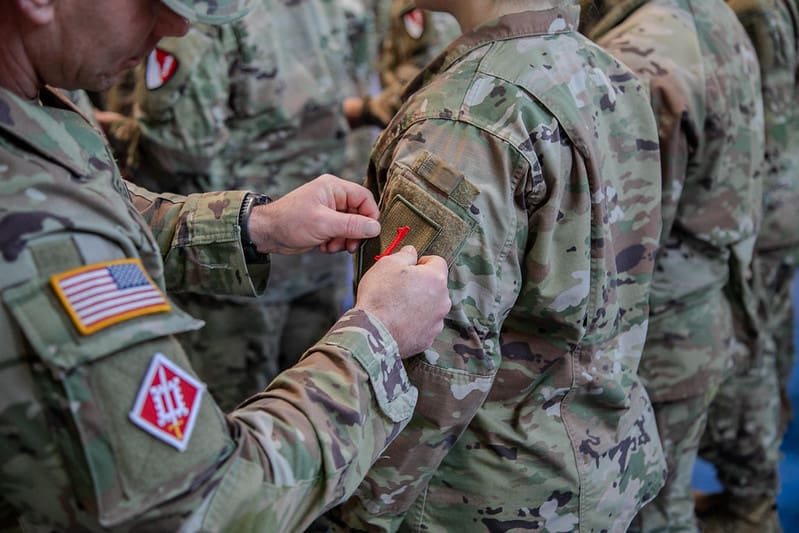
During a Dec. 16 ceremony held at King Field House on Fort Riley, soldiers representing the 5th Engineer Battalion “patched over” to the 1st Infantry Division. Patching ceremonies are held to welcome units to a new headquarters. The changing of patches symbolizes acknowledgement and acceptance into the new chain of command.
In compliance with the Army 2030 Design, the Army is restructuring to meet force requirements which necessitated the realignment of 5th Engineer Battalion from 36th Engineer Brigade to 1st Infantry Division. The addition of the “Fightin’ Fifth” to the “Big Red One” family adds combat power and lethality to the First Division.
The shoulder sleeve insignia, or unit patch, dates to World War I when units wanted to easily identify their members and show pride in their division. The 5th Engineer Battalion changed from the red and white of the engineer corps to the green and red of the 1st Infantry Division. While letting go of their “Little Seahorse Division” patch is bittersweet, joining the ranks of the storied First Division is an honor.
The 1st Infantry Division traces its roots to World War I when it attacked and defeated the German forces in the small village of Cantigny, earning the first American victory of that war. The First Division’s history continues through World War II, Vietnam, Desert Storm/Desert Shield, and the Global War on Terror, to the modern rotational forces present in Eastern Europe. It’s said that the sun never sets on the “Big Red One.” With the division’s current deployment of the 1st Armored Brigade Combat Team “Devil,” the sentiment rings true.
The 5th Engineer Battalion traces its history back to 1861, with the establishment of “Battalion of Engineer Troops” supporting the Army of the Potomac during the Civil War. Their lineage is inlaid in the history of the U.S. Army, serving in World War I, World War II, Desert Shield/Desert Storm, Operation Iraqi Freedom, Operation Enduring Freedom, and Operation Inherent Resolve. Across its long history, the 5th Engineer Battalion has consistently demonstrated its versatility and commitment to excellence, earning its reputation as a vital asset in both combat and engineering operations. The First Division is honored to add the legacy of the “Fightin’ Fifth” to the 108 years of service the “Big Red One” patch signifies.
“The Fighting Fifth brings with it an incredible set of unique capabilities and incredible leaders and soldiers that ultimately make the Drumfire and Danger teams more lethal and capable when called up to fight and win our nation’s wars,” said Col. Patrick H. Kaine, 1st Infantry Division Artillery “Drumfire” Brigade Commander, the host for the ceremony.
Following the ceremony, Maj. Gen. Monté Rone, 1st Infantry Division Commander, highlighted the importance of building excellence and cohesive teams throughout the formation. “The legacy of the Fightin’ Fifth is woven into the very fabric of our Army, dating back to the Civil War. From the fields of Europe to the deserts of the Middle East, you have built a reputation of distinction.”
Rone added, “Today, your legacy joins with the BRO’s, 108 years of service, sacrifice, and warfighting excellence symbolized by the Big Red One patch. To the soldiers and families of Fightin’ Fifth, you are now part of the future of the Big Red One. We look forward to the great things we will accomplish together. Welcome to the team. Duty First!”
As part of the Army 2030 initiative, the 5th Engineer Battalion Headquarters and its associated companies will relocate from Fort Leonard Wood, Missouri to Fort Riley, Kansas by October 2026. This will bring nine companies and nearly 250 Soldiers and their families to the Flint Hills region.