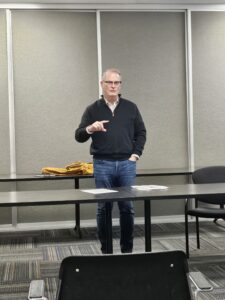
A focus group meeting was held for USD 379 on September 30th at Lincoln School, with about 32 people in attendance. The meeting was ran by HTK Architects, the firm that was hired to run the bond issue.
Architects Maria Kutina, principal in charge, and Noah Mediavilla, project manager, started with a presentation about the bond issue process, which includes research, vision, program, collaboration, and resolution/voting.
Kutina also spoke on the current climate of public schools, which have come to require bonds in order to afford asset maintenance.
“So many more schools are doing bond issues because that’s really the only bucket you have where you’re able to spend more,” she said. Adding that the state maxes out school district capital outlay funds at eight mills, which is $1.5 million for USD 379.
“There’s a list of really reasonable needs, but we have to have the money to pay for that.”
That list includes things like roof repair, HVAC, parking lot improvements, and other deferred maintenance that were put off due to a lack of funds.
USD 379 superintendent Brett Nelson, said the district has had a bond issue for decades to help offset district costs.
“We have wonderful facilities here that are very well taken care of,” he said. “I think that shows our district and our board have been good patrons of the dollars they do collect to pay for their facilities.”
In addition, Nelson pointed out a chart, which showed Clay County is just the third-lowest mill levy in the area, above Southern Cloud and Concordia. Clay County sits at 48.57, with Concordia at 46.966 and Southern Cloud at 45.87. Meanwhile, Solomon sits at 66.116, Riley County at 61.155, Rock Creek at 58.944, and Wamego at 55.099.
“We have a couple options, but the ultimate outcome by the time we get done, our district is set up in really good position from a deferred maintenance position for the next 15 years,” he said. “These are projects that can help set our district up for success.”
The Feedback
Attendees were asked to talk amongst themselves on provided questions with one group member speak on their main take-aways. Although some consolidation options were discussed in Clay Center, nothing about consolidating Wakefield was publicly discussed.
Consensus did not like the idea of separating preschoolers from the rest of the elementary students, citing fewer transitions for students and an easier transition to kindergarten.
Multiple tables said they wish there was a third bond option to build a separate prek-5 school at a neutral location. This was referenced by many attendees, who brought up the age/inconsistent layout of Lincoln, and the inability for growth if segmenting Lincoln into a three-section school.
One table pointed out the potential to add sections, citing this year’s kindergarten class projection at 57, when 71 enrolled.
“If we need more then we don’t have anywhere to go. Are we doing this the right way and for the right reasons? Or are we doing it to do it?” Garfield Principal, Rachel Roberts, who also has elementary-aged children, said on behalf of her table. Roberts also pointed out that with a 20-year bond, the students who would be graduating at the end of the bond’s lifespan are not even born yet.

“Yes, the statistics are showing us one thing, but it’s still too far away to tell what will happen. It’s never a good idea to have just enough.” Roberts added that she is pro-bond, but has concerns about the current consolidation option.
Other tables agreed, asking about the idea for a third potential bond issue and not liking the idea of adding on to an 88 year-old building, which already has multiple additions.
Safety and improving secure entrances to the building was another key point. Others said staying current on maintenance should be a main focus of the bond.
“With inflation costs and the budget to run these buildings going up we need to look at how to get some operating costs down so we can continue to have safe and secure buildings,” said Matt Thompson, district parent and owner of Advanced Electric. “The minute you let off the gas you’ll be 10 years behind on maintenance. You can’t stop. When things are neglected too long it’s too expensive to fix. We need to make it more efficient because there’s nothing that’s getting cheaper.”
Members also believe there are some in the community that have a lack of trust toward the district. Multiple attendees said they believed it may be difficult to get voters to agree on a path moving forward, and that clear communication will be an important factor before the vote. While they also cited neighboring school districts who are upgrading their facilities, while “putting an expensive Band-Aid” on our district is not a point that would draw in new residents.

“I was surprised at how low our mill levy is compared to others in the state,” said Justin Tadtman, district parent and Clay Center Farm Bureau agent. “I appreciate what the district has done to keep the buildings maintained. It’s a kudos to our staff and district and what they do with the money, cause it’s a great place. And it’s not about having the flashiest stuff, it’s about making sure our school district is a place that is attractive for people to move here.
“We moved here so I know that life. We can’t just say, ‘No more raising the mill levy’ we have to get to that spot where we raise it. We’re not in that world anymore, things cost more and we’ve got to fund them.”
The next public meeting to discuss the potential bond will be held on November 3rd at 6 pm at Garfield School.